Course overview
Collaborate with world-leading researchers, with access to the state-of-the-art facilities in hydrogen, carbon capture, CO2 mineralisation, gas and liquid separation membranes, biofuel and biochar, and advanced chemical engineering software.
You graduate with an appreciation of societal requirements for sustainable development and corporate responsibility in industry, giving you the foundations to secure jobs with top-tier employers.
This course includes an integrated masters - you study three years at undergraduate level and one year at postgraduate level.
Top reasons to study chemical engineering at Teesside
- Financial awards: you may be eligible for a number of scholarships and awards.
- Maths support: strengthen your maths with a free online Mathematics for University course before you start your course.
- Industry links: we have long-term industrial links and joint projects with the top employers, offering you significant opportunities to gain practical experience and work on industry-focused projects.
- £2,000 Accommodation Award: you may be eligible for £2,000 towards your accommodation fees if you live outside the TS postcode and are in your first year of study. (Find out more).
- International visits: you have opportunities to travel internationally through student mobility visits or spending a semester studying abroad with one of our partners in countries such as China, the Czech Republic, Spain and Malaysia.
- Graduate Success: 100% of MEng (Hons) Chemical Engineering students go on to work and/or study 15 months after the course (Graduate Outcomes Survey 2019-20 and 2020-21, tees.ac.uk/source).
Course details
Course structure
Year 1 core modules
This module introduces the range of mathematical skills that are relevant to an engineering degree. You revisit and develop your knowledge of the fundamentals of algebra, trigonometry and basic statistics. The central ideas of vectors, matrices, complex numbers, and differential and integral calculus are also examined.
Throughout the module you develop a range of mathematical skills and techniques fundamental to the solution of engineering problems. You also advance your skills in selecting and applying mathematical techniques.
This module is delivered through a combination of lectures and tutorial sessions.
Heat Transfer and Fluid Mechanics
You gain a fundamental knowledge of fluid flow through pipe-work systems and the associated design tasks. You are introduced to the techniques used to predict the behaviour of fluids in Chemical Engineering applications and investigate the differences between Newtonian and Non-Newtonian fluids.
The importance of stoichiometry, mass and energy balances and recycle operations is widely known and accepted in the chemical, biochemical and other related industries. You explore concepts and skills necessary to develop the skills necessary to work as a chemical engineer.
Practical Skills for Chemical Engineers
You work in a team in order to solve a process industry based problem. It gives you an understanding of your own knowledge and limitations and the importance of working with other people to solve a chemical engineering based problem. You gain a fundamental understanding of the operation of the chemical industry with respect to commercial project delivery; health and safety and ethical considerations.
Science for Chemical Engineers
This module introduces a range of key concepts in chemistry which provide a basis for understanding subsequent study in areas including analysing, synthesising and identifying compounds, and industrial production.
You learn about the nature of matter and why different substances behave the way they do. Understanding the properties of a substance is essential whether you’re designing a plant to manufacture it on a multi-tonne scale or working out how to alter its structure to improve its properties, for example as a drug or construction material. You also learn how the fundamental principles of chemical equilibrium, energetics and reaction rate are developed, and come to understand the prediction of reaction behaviour when process conditions are changed.
This is a 20-credit module.
Thermodynamics for Chemical Engineers
You explore the concepts of chemical engineering thermodynamics.
Develop an understanding of the engineering thermodynamic properties of pure working fluids. A series of thermodynamic principles are defined, developed and then applied to solve chemical engineering related problems of increasing difficulty, in particular derivation of the first and second laws of thermodynamics are explored and then applied to real world analysis of a range of heat-power cycles.
Year 2 core modules
You develop mathematical knowledge in differential equations and numerical methods and extend your base of techniques to solve a variety of problems which arise in engineering domains. The emphasis is on developing competence in the identification of the most appropriate method to solve a given problem and its subsequent application.
This module provides you with the opportunity to solve industrially relevant process design problems as part of a team. You develop employability skills such as project management, presentation of work, research and commercial awareness to support problem solving in a technical context.
You learn about the importance of control systems in industrial production processes, and describe fundamental concepts of linear control including feedback, Proportional-Integral-Derivative (PID) control, system dynamic response and controller tuning.
Mathematical modeling of systems based upon rate and balance equations are demonstrated, together with methods of designing feedback controllers. You use computer software to develop models of typical industrial systems and simulate their dynamic response under stated conditions.
Practical and Professional Skills
This module allows you to carry out appropriate experiments in support of mass transfer, heat transfer, reaction engineering and process control. This involves carrying out supervised experiments and producing appropriate reports in an approved format. You make some formal presentations to outline efficient laboratory reporting, error analysis techniques and preparation of risk assessments.
In most production units, chemical engineers separate the desired product from the other compounds and concentrate it to give the desired product specification.
You gain a sound understanding of mass transfer theory. You learn about mass and energy conservation and particle technology and the basic concepts behind the design and operation of mass-transfer equipment.
The core of most chemical processes is a chemical reactor to produce the desired product. Sometimes the components of the reaction may be biologically active.
You gain a sound understanding of the fundamental concepts of reaction engineering in chemical and biochemical systems. You make use of the essential knowledge of mass and energy conservation, reaction equilibria and kinetics and are introduced to the basic concepts behind the design of different types of chemical and biochemical reactors.
Year 3 core modules
You broaden your knowledge and deepen your understanding of process unit operations and the underpinning science. It provides you with design methodologies for complex unit operations involving multicomponent distillation, liquid-liquid extraction, gas absorption, membrane processes and chromatography. You gain an in-depth understanding of the application of thermodynamics to mixtures.
Chemical Engineering in Industry
Develop your appreciation and understanding of process safety, and learn to broaden your understanding of the current industrial landscape of chemical engineering.
Environment and Sustainable Processing
You explore the environmental impact of industrial and human activity, and the need for a sustainable approach for environmental engineering solutions. You examine sustainable strategies for air, water and land pollution, focussing on environmental management and sustainable engineering.
This is a 20-credit module.
Integrated Masters Chemical Engineering Project
Consider the design work introduced throughout the course into a single cohesive design exercise. It is designed to meet the requirements set down for process design for Masters students for accredited degrees by the IChemE.
The project follows standard industrial design methodologies from initial design brief through to complete design of a full chemical process.
You develop your understanding of reaction engineering and apply your knowledge to complex and multi-phase reactions/reactors systems. You are also introduced to catalyst preparation and characterisation, and the use of catalysis in reaction engineering.
Optional work placement year
You have the option to spend one year in industry learning and developing your skills. We encourage and support you with applying for a placement, job hunting and networking.
You gain experience favoured by graduate recruiters and develop your technical skillset. You also obtain the transferable skills required in any professional environment, including communication, negotiation, teamwork, leadership, organisation, confidence, self-reliance, problem-solving, being able to work under pressure, and commercial awareness.
Many employers view a placement as a year-long interview, therefore placements are increasingly becoming an essential part of an organisation's pre-selection strategy in their graduate recruitment process. Benefits include:
· improved job prospects
· enhanced employment skills and improved career progression opportunities
· a higher starting salary than your full-time counterparts
· a better degree classification
· a richer CV
· a year's salary before completing your degree
· experience of workplace culture
· the opportunity to design and base your final-year project within a working environment.
If you are unable to secure a work placement with an employer, then you simply continue on a course without the work placement.
Final-year core modules
Advanced Chemical Engineering Design
This module will enable you to explore the use of industrial standard modelling and simulation software in the design of complex chemical engineering unit operations. You will use the knowledge and skills gained to produce a computational design of a chemical plant.
You will also learn about the business and regulatory aspects of process design and development in chemical engineering.
The assessment comprises of 100 percent course work. It consists of group produced portfolio where evaluation of an individual contribution will be based on tutor moderated self and peer assessment.
Integrated Masters Research Project
This module extends the development of independent learning skills by allowing the student to investigate an area of engineering for an extended period. The student will work independently or in a small team, but will produce individual work.
Training will be given in writing technical reports for knowledgeable readers and the student will produce a report/dissertation of the work covered. In addition, the student will give an oral presentation, poster presentation or both. The topic can be in the form of a research project or a design project. Key skills in research, knowledge application and creation will be developed through keynote lectures and self-managed independent study.
The process industries typically record a large amount of process data via their Supervisory Control And Data Acquisition (SCADA) systems. Appropriate analysis of this data allows for better production quality, early fault detection and ultimately better safety checks. You study the appropriate system identification techniques to model processes on the basis of this data. You look at Statistical Process Control (SPC) techniques that enable critical analysis of data in order to make informed judgement in the running of continuous and batch processes. You explore the use of the industry standard Six Sigma technique to improve process plant operation.
and two optional modules
Advanced Drilling Engineering and Well Completion
Develop an understanding of drilling engineering, the process of well completion, work-over as well as stimulation to improve well performance.
Explore drilling systems such as hoisting systems, power systems, circulation systems as well as hydraulic systems. You learn drilling muds’ properties and behaviour, the blow-out-preventer and other safety measures on drilling process. It will also present drilling bits types and performances.
This module covers incompressible and compressible aerodynamics applicable to flight of subsonic and supersonic aircraft, and introduces hypersonic flow applicable to re-entry vehicles.
The content of this module includes a revision of the fundamental fluid flow and thermodynamic governing equations, subsonic and supersonic around wings, flow through nozzles and diffusers, oblique shock waves and expansion waves, fundamentals of boundary layers, convective heat transfer, viscous high temperature flows, and experimental methods for hypersonic flows.
The module content will be delivered through the use of lectures, seminars, laboratory sessions, problem solving tutorials and IT laboratory sessions providing an opportunity to explore complex flows through the use of CFD codes.
Assessment will comprise of a laboratory report compiled from practical laboratory investigations and an end exam.
This module develops an insight into the principles of electrochemical systems and the supporting theory. Also, applications of this technology such as electrolysis processes, batteries, and fuel cells will be considered. The module examines the relevant kinetics and thermodynamics theory to model the mass transfer and diffusion effects observed. The material will be delivered through lectures developing concepts and through embedded problem-solving seminars.
Hydrocarbon Exploration and Production Engineering
This module will provide a detailed understanding of hydrocarbon exploration and production. The module will cover different methods of hydrocarbon exploration, drilling engineering, the process of well completion, and work-over. Moreover, it covers the oil and gas production systems including wells, pipelines, separators and chokes. The inflow performance relationships (IPR) for oil and gas wells, as well as well performance analysis will be included in this module. The module will also provide the understanding for surface production facilities and operations used in crude oil treatment and natural gas re-conditioning such as sweetening and dehydration. This module will be delivered through a combination of lectures and tutorial sessions.
Identification and Model Predictive Control
You develop the methods and techniques associated with system identification. You learn how these techniques can be used in the formulation of adaptive and model based control schemes. You consider the practical implementation of these control schemes.
The module provides an understanding of crude oil fractions and components enabling the study of phase behaviour of reservoir fluids as a function of temperature and pressure. Different equations of state are used to analyse the pressure-volume-temperature (PVT) correlations.
The module demonstrates how construction of compositional fluid models, using an industry standard reservoir simulator, enables the investigation of reservoir fluid properties and behaviour. In addition, oil field corrosion and scaling mechanisms as well as monitoring and inhibition methods are discussed.
Petroleum Reservoir Engineering
You study the key concepts of reservoir engineering, including reservoir properties, single and multiple-phase fluid flow through porous media. You have an introduction to various reservoir rock types including carbonate and sandstone rocks, outlining the geological aspects of hydrocarbon reservoirs. You also discuss formation evaluation based on well-testing and well-logging interpretations.
Process Improvement and Optimisation
Although the chemical industry has evolved within the last decade, there is still demand and ongoing need for process improvement and optimisation, to align technology to market needs by producing “lean and mean” designs.
This module provides you with a sound understanding of the complex concepts of process improvement and a working knowledge of the sophisticated optimisation techniques that are applied to the design and control of chemical engineering processes.
Based on a thorough technical analysis of the chemical process, quality improvement measures are proposed to optimise the reaction and operation conditions. You examine the use of catalysts with high activity and selectivity, along with advanced flow reactors, while designing a new technology or re-designing an existing one. You are introduced to standard optimisation techniques and you learn to identify the most beneficial applications.
This module is designed to present an advanced level of study in Risk Management in projects. Students will explore a range of tools and techniques used in risk identification, qualitative and quantitative risk analysis, risk planning responses, PERT and risk monitoring. Students will learn about financial risk, project appraisal methods and the application of a decision tree within a project. Students will gain awareness of probability theory that represents the corner stone of risk management. Invited speakers from the industry will give an overview of risk management in different projects (e.g. IT, Finance, Construction, and Oil & Gas).Students will be required to work in group on project case studies which apply risk management theory. In addition, students will gain a hands-on experience in applying an industry standard software tool to variety of scenarios of risk factors. Students will develop a deep understanding of the systematic process of Risk Management and application of industry standard software.
This module investigates a range of applied Quality Management techniques and has been designed to enable students to develop the skills necessary to apply these techniques to their own work environment. This module also examines the appropriate statistical techniques in Quality Control, Auditing, Supply Chain Management and a range of Accreditation Schemes including BRC, EFSIS, ISO, UKAS and Industry Standards. In course assessment (ICA) is via a 5000 words written piece of work, with a weighting of 100%.
Sustainability in Chemical Engineering
This module covers environmental assessments such as life cycle assessment, environmental impact assessment and environmental management system on environmental impacts from industrial and human activities. The framework of this module also includes understanding of sustainable engineering strategies such as clean technology and renewable energy to address current environmental issues.
A case study in environmental impacts and development of sustainable engineering alternatives will be assessed by means of an in-course assignment (100%).
Water and Wastewater Treatment Processes
This module will develop an understanding of the water and wastewater treatment processes and will enable the students to apply them in an engineering context. Relevant current and future challenges associated with the water sector will be discussed to increase the awareness of the students and help them propose potential solutions.
Lectures will deliver the theoretical knowledge of water and wastewater treatment processes and the associated challenges within the water-energy nexus. The seminars will enable the application of theoretical knowledge to design problems.
Case studies from research and industrial sources will investigate the applicability and effectiveness of the course materials and highlight the potential opportunities and challenges.
Modules offered may vary.
How you learn
You learn through lectures, seminars and hands-on lab sessions. You are also expected to undertake self-guided study time to review lecture notes, prepare coursework assignments, work on projects and revise for assessments.
Some of your learning is based around case studies, following visits to local industries.
Intensive problem-solving weeks involve you working as part of a team to find a solution to an engineering problem, helping you enhance your team-working, communication, leadership and other transferrable skills.
Chemical Engineering facilities:
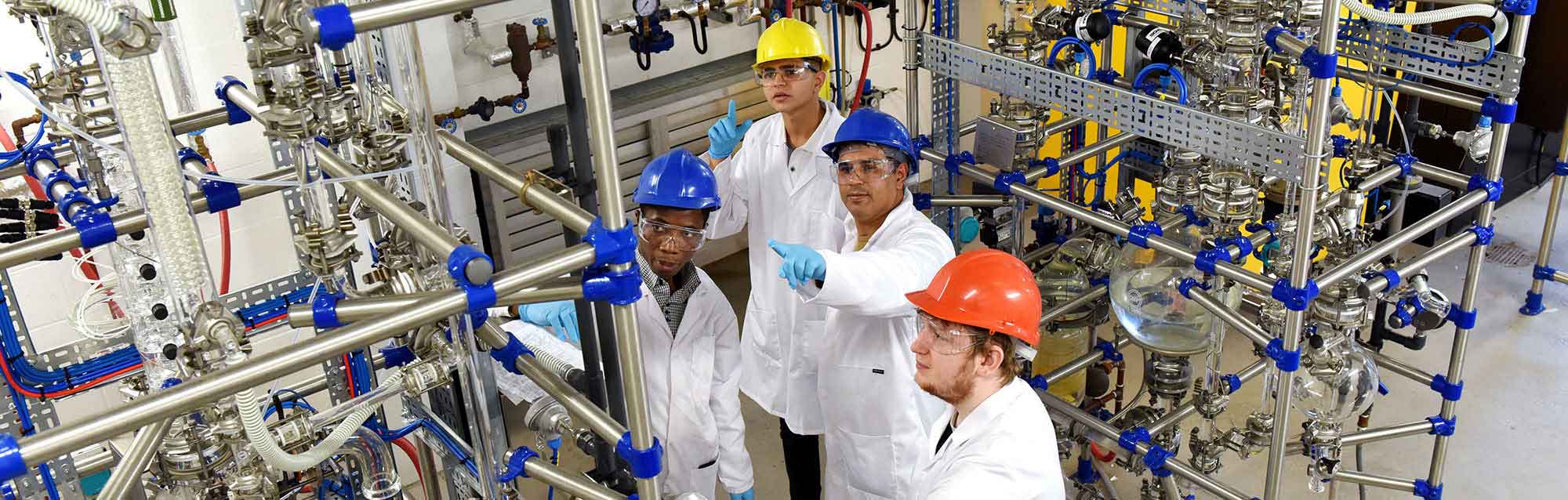
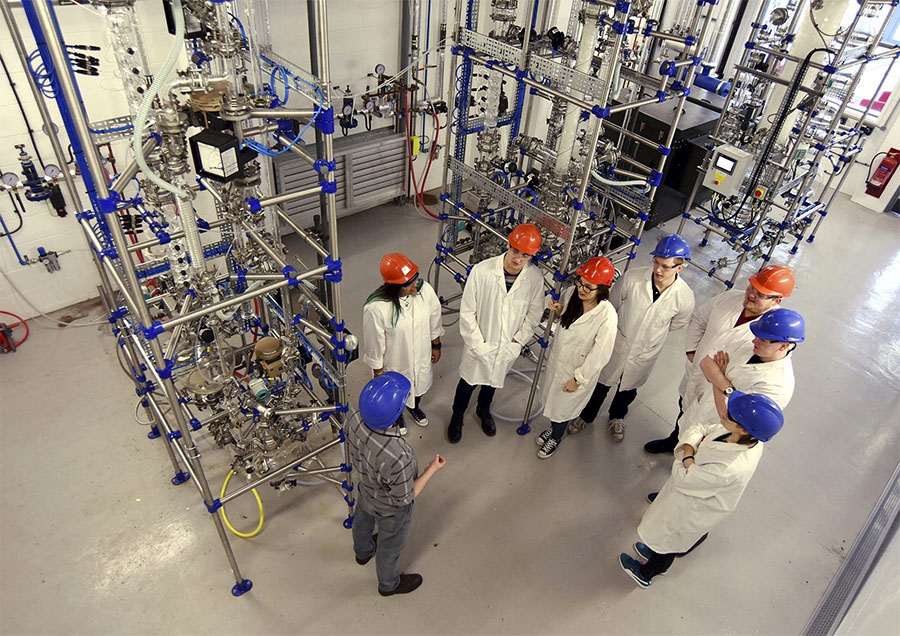
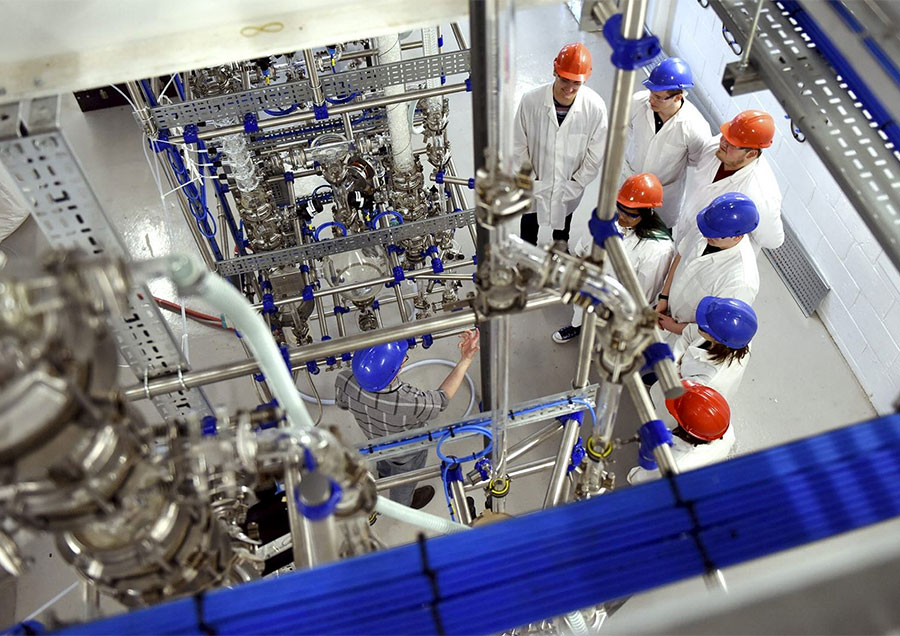
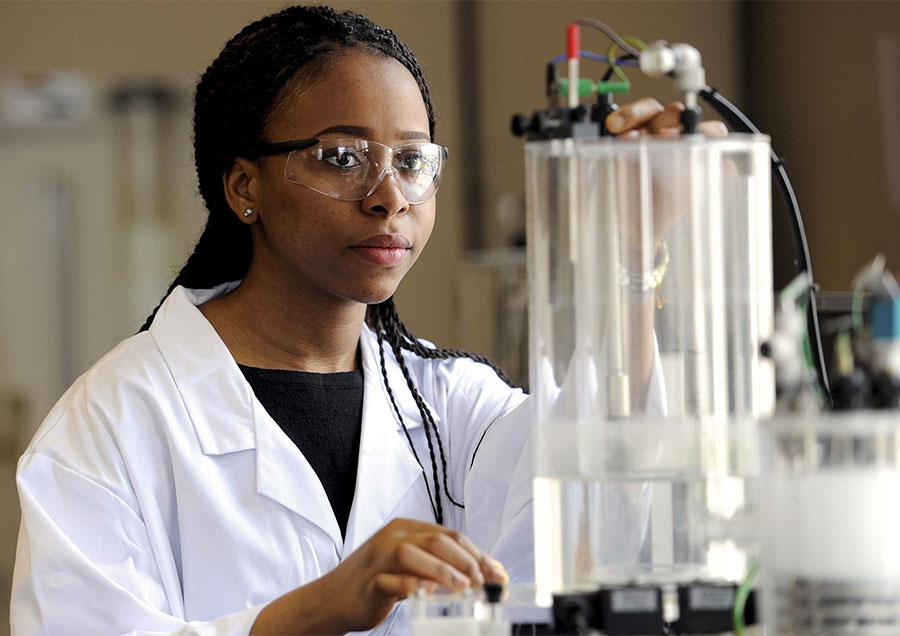
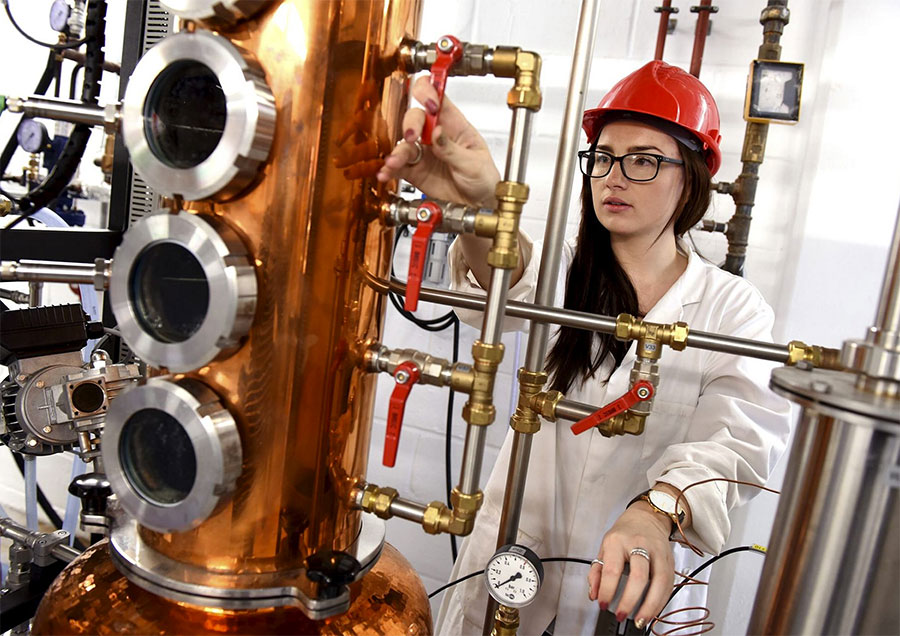
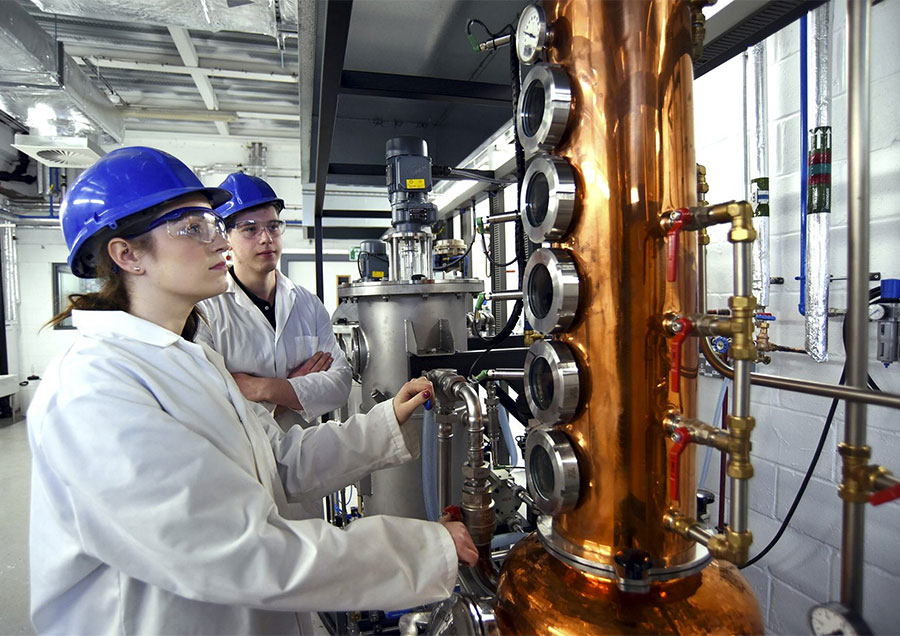
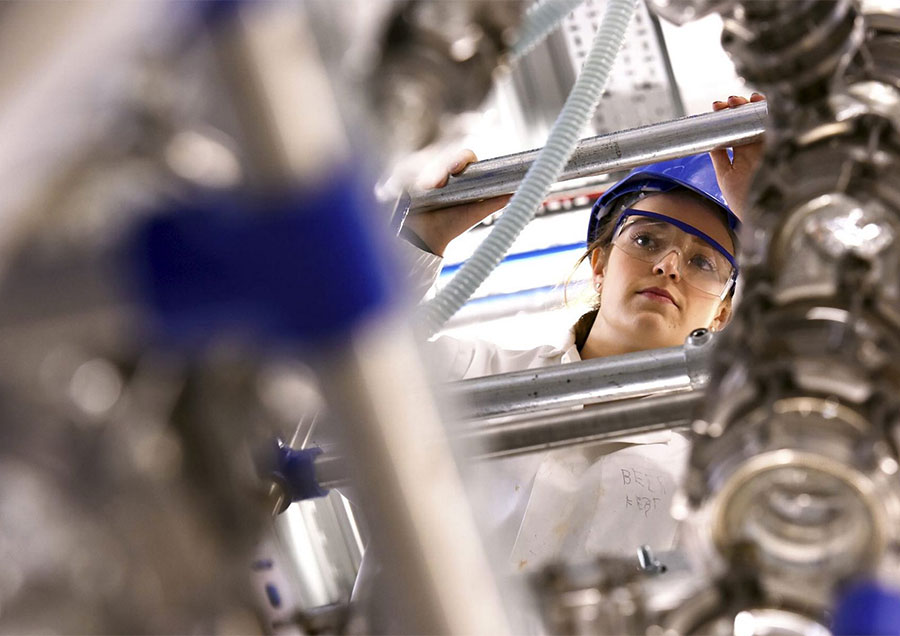
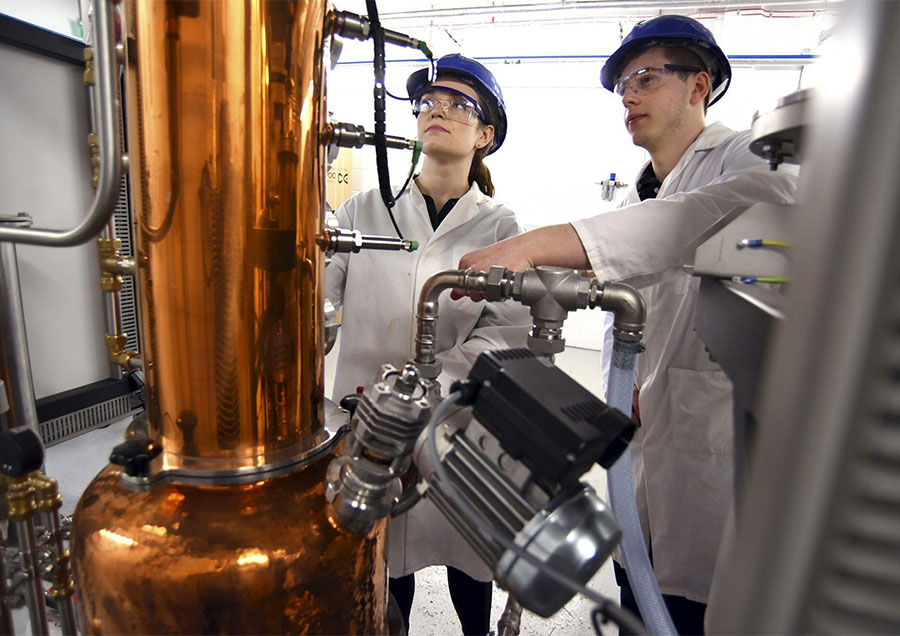
Within the engineering department we have world class chemical engineering facilities for teaching and research. All our labs are equipped with state-of-the-art experimental equipment and follow strict operational, hazard and safety regulations to ensure a safe working environment.
• Pilot laboratory.
• Unit process and operation laboratory.
• Wet laboratory.
• Hydrogen laboratory.
• Greenhouse gas separations laboratory.
• Process design, modelling and simulation laboratory.
• Biochar and water treatment laboratory.
How you are assessed
You are assessed through coursework assignments, project reports, lab reports, presentations and formal exams.
Our Disability Services team provide an inclusive and empowering learning environment and have specialist staff to support disabled students access any additional tailored resources needed. If you have a specific learning difficulty, mental health condition, autism, sensory impairment, chronic health condition or any other disability please contact a Disability Services as early as possible.
Find out more about our disability services
Find out more about financial support
Find out more about our course related costs
Entry requirements
Entry requirements
112-128 points including maths, from any combination of acceptable Level 3 qualifications. Examples include A-level, BTEC, Access to HE Diplomas, Scottish and Irish Highers, T-Levels, or the International Baccalaureate.
We accept the following T-Levels:
- Design and Development for Engineering and Manufacturing
- Design, Surveying and Planning for Construction (specialism Civil Engineering)
- Maintenance, Installation and Repair for Engineering and Manufacturing from City & Guilds.
Find out how many points your qualifications are worth using the UCAS tariff calculator.
Accredited prior learning
If you’ve already completed an HNC, HND, or other relevant higher education study in a related subject, you may be able to use this to gain credit exemptions or advanced entry. This means you could build on your previous study and avoid repeating content you’ve already covered.
Alternative routes into this course are available if you have not met the entry requirements as listed.
International students who need a student visa to study in the UK should check our international web pages on acceptable international qualifications and UKVI-compliant English language requirements.
For general information please see our overview of entry requirements.
International applicants can find out what qualifications they need by visiting our international country pages.
You can gain considerable knowledge from work, volunteering and life. Under recognition of prior learning (RPL) you may be awarded credit for this which can be credited towards the course you want to study.
Find out more about RPL
Employability
Career opportunities
Our graduates are working across sectors including; pharmaceutical, energy, recycling, battery production, pulp and paper, cement, fertilisers, chemical, food production, biochemical production/biotechnology, and consultancy companies.
As the world transits to sustainable and green technologies many new areas have emerged that need chemical engineers, these include hydrogen-ammonia economy, biofuels, emission mitigation, and novel materials. The sector-wise distribution of chemical engineers employed in different sectors such as oil, gas, nuclear, water, manufacturing and pharmaceutical.
You graduate qualified to work within research and the development of innovative and sustainable products and processes, production and process technologies and advanced technical support. Typical roles involve process engineers, sustainability managers, production in-charge, waste/energy managers, waste minimisation specialists, energy monitoring consultants, research scientist, environmental or carbon management officers, and government advisors.
The course trains you to start your own company or join a start-up. As a chemical engineer, you are trained to draw on resources and ideas from a variety of fields, making you adaptable, creative and able to thrive in a fast-paced start-up environment.
Information for international applicants
Qualifications
International applicants - find out what qualifications you need by selecting your country below.
Select your country:
Useful information
Visit our international pages for useful information for non-UK students and applicants.

 MEng Chemical Engineering (With Industry)
 MEng Chemical Engineering