Turner Prize 2026 Exhibition opens in Middlesbrough
MIMA, Middlesbrough Institute of Modern Art, today unveiled an exhibition of works by the four artists shortlisted for this year’s Turner Prize: Simeon Barclay, Kira Freije, Marguerite Humeau, and Tanoa Sasraku. The winner will be announced on 10 December 2026.
MIMA, which is part of Teesside University, is an international art gallery and museum in the heart of Middlesbrough. The Turner Prize exhibition is open from 26 September 2026 to 29 March 2027.
Simeon Barclay creates environments where objects, architecture, sounds, video and images collide to create a deeply personal and often humorous portrait of British culture. He is nominated for his performance The Ruin, commissioned by the Roberts Institute of Art and presented at the Institute of Contemporary Arts (ICA), London, The Hepworth Wakefield,West Yorkshire, and New Art Exchange, Nottingham.
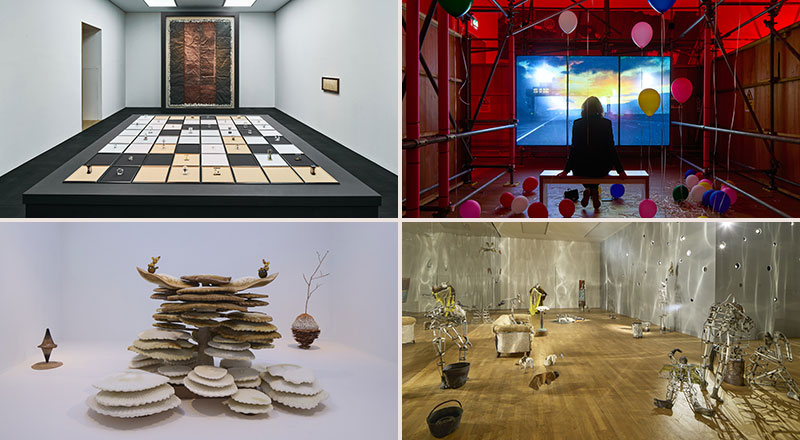
For his presentation of The Ruin at MIMA, Barclay has made material the energy of the live performance through a spatial intervention, resonating with his own voice. It invites the audience on a journey back in time to when the M62 motorway was being carved through the Pennines; one of the most significant infrastructural projects of postwar Britain. The work speaks to the ambition of the planners and the freedom that the project offered, particularly to the residents of Huddersfield and its surroundings, where the artist spent his youth. The temporary structure of scaffolding suggests that our shared history is also a work in progress, suspended between construction and completion. The performance also takes the audience into more intimate settings, such as the artist’s childhood living room where his father’s presence dominates.
Kira Freije creates sculptural worlds inhabited by human and animal forms. She is nominated for her solo exhibition Unspeak the Chorus at The Hepworth Wakefield, West Yorkshire, co-commissioned with Modern Art Oxford.
In Freije’s Turner Prize exhibition, groups of figures occupy the gallery space. Their open structures are built from slender welded steel strips, creating volumes or forms that resemble drawings in space, with faces, hands and feet cast in aluminium. Walls of scattered points of light suggest a night sky, reflected from mirrored walls across the sculptures. A gentle mist gives the light structure and is treated by Freije as another material within the installation. There is a sense of connection between the figures, but equally each appears absorbed by its own thoughts. Their gestures and body language suggest moments of care, grief, companionship and uncertainty, although Freije does not impose a single narrative. They hold fragments of feeling and leave space for viewers to form their own interpretations. Found textiles, glass and salvaged materials appear throughout. Many of the fabrics carry traces of previous use. Animal forms are dispersed across the installation, including some referencing the artist’s dog, Laska, and birds in flight. They are not performing but existing, bringing an immediate and unguarded quality to the work.
Marguerite Humeau’s practice brings together sculpture, sound and light, moving between prehistoric pasts, the present and imagined futures to explore life, death, transformation and survival. She is nominated for her solo exhibition Torches at ARKEN Museum of Contemporary Art, Ishøj, Denmark, and Helsinki Art Museum (HAM).
In Humeau’s exhibition at MIMA, beings emerge as guides and companions under a celestial sky of translucent glass orbs. A monumental elephant matriarch approaches death and guardians protect precious substances. Across the exhibition, death is not an ending but a moment of renewal, allowing something new to emerge. Research and collaboration are central to Humeau’s practice. Working with zoologists, anthropologists, foragers, clairvoyants and others, she brings together different forms of knowledge to consider new ways of thinking about our place within the history of life in the universe. She looks to the intelligence found in animals, insects, fungi and micro-organisms, asking what they can teach humans about co-operation, resilience and survival. These ideas extend into the physical space. Soft white flooring creates a shared landscape for Humeau’s sculptural beings, recalling the networks that connect different forms of life. As visitors move across it, their footsteps leave traces and gradually change the space, reminding us that we too are part of a much larger, interconnected living world.
Tanoa Sasraku explores materials and their narrative potential through the prism of human power structures. Her artworks make connections between seemingly distinct material processes, found objects and familiar symbols, inviting the viewer to be curious about where they came from, who they belong to and how they were made. She is nominated for her solo exhibition Morale Patch at the Institute of Contemporary Arts (ICA), London.
For her Turner Prize exhibition, Sasraku investigates the dynamics, instruments and aesthetics of power that facilitate “extractivism” – the aggressive, large-scale removal of natural resources for profit. Materials and objects in the exhibition include raw pigment found in the earth in Cornwall and Ghana, used to saturate a paper suit pattern; liquid crude oil contained inside highly processed, petrochemically derived acrylic paperweights; and stacks of bleached stripes on brittle sheets of paper held together with binder clips, each titled with the battles for which they faintly signify. The support structures for the work are designed and crafted to impose a sense of gravitas and pride in the spoils of extraction and war. The darkness of the rubber floor absorbs the light and focuses attention on the objects and their materiality.
Alex Farquharson, Director, Tate Britain, said: “Tate Britain frequently works with museums and galleries across the UK to bring the Turner Prize to the widest possible audience, and I am delighted that this year’s presentation is hosted by MIMA in Middlesbrough. The Turner Prize has always been a catalyst for conversation and debate, and MIMA’s deep engagement with its local community makes it a wonderful setting for this year’s exhibition. Art has a unique power to bring people together, open new perspectives and spark conversations that extend far beyond the gallery. I hope audiences in Middlesbrough and visitors from across the UK will embrace the work of these four exceptional artists, whose presentations reflect the energy and diversity of contemporary British art today.”
Dr Laura Sillars, Director of MIMA and Dean of Culture & Creativity at Teesside University, said: “Artists have a unique capacity to invite us to look again at the world around us and to ask: what if? What if things were understood differently or imagined anew? Bringing Turner Prize 2026 to MIMA creates a meeting between four exceptional artistic practices and the histories, experiences and imaginations of Middlesbrough, Teesside and the North East. As part of Teesside University, MIMA lives at the meeting point of art, learning and public life. We are deeply grateful to the artists and to everyone whose care, generosity and hard work have brought us to this moment.”
Professor Mark Simpson, Vice-Chancellor of Teesside University, said: "The Turner Prize coming to Middlesbrough is a powerful statement about the role that culture and creativity play in the life of our communities. Teesside University is committed not only to education and research, but also to the social, cultural and economic vitality of our region. Through MIMA, we are creating opportunities for people to engage with world-class contemporary art and the important conversations it inspires.
Art and culture help us understand our communities, challenge assumptions and imagine new possibilities for the future. Hosting the Turner Prize places Middlesbrough firmly on the national cultural stage, showcasing the creativity, confidence and ambition that define Teesside today. We are proud to support an event that celebrates artistic excellence while shining a spotlight on our region and its people."
Chris Cooke, Mayor of Middlesbrough, said: “Having the Turner Prize at MIMA is an incredible opportunity for our residents to see cutting edge art in their hometown. I hope it inspires our young people to dream about what's possible. Our town centre is home to students at Teesside University’s School of Arts and Creative Industries and the Northern School of Art - why shouldn't it be them in a few years’ time? Middlesbrough's creative and cultural scene is thriving as we aim to become the UK City of Culture 2029. Hosting the Turner Prize gives us a chance to show off what we have to offer to people across the country."
Ben Houchen, Tees Valley Mayor, said: “Bringing the Turner Prize to Middlesbrough is a huge moment for our region and puts us firmly in the national spotlight. We said from the start this would bring visitors, investment and opportunity - and now people from across the country will be coming to Middlesbrough to see one of the world’s biggest arts events. This is another chance to show the country the ambition, creativity and talent we have right here on Teesside.”
One of the best-known prizes for the visual arts in the world, the Turner Prize aims to promote public debate around new developments in contemporary British art. Established in 1984, the prize is awarded each year to a British artist for an outstanding exhibition or other presentation of their work. The Turner Prize winner will be awarded £25,000 with £10,000 awarded to the other shortlisted artists.
MIMA, Middlesbrough Institute of Modern Art, is an international art gallery and museum, home to The Middlesbrough Collection of over 2,350 artworks. As part of Teesside University, MIMA is dedicated to innovative research and artistic excellence. MIMA works in collaboration with communities and partners across the Tees Valley, nationally, and globally.
The members of the Turner Prize 2026 jury are: Sarah Allen, Head of Programme, South London Gallery, Joe Hill, Director & Chief Executive, Yorkshire Sculpture Park, Sook-Kyung Lee, Director, The Whitworth and Professor of Curatorial Practices at The University of Manchester and Alona Pardo, Director, Arts Council Collection, UK. The jury is chaired by Alex Farquharson, Director, Tate Britain.
The Turner Prize 2026 exhibition is curated by Dr Claire Louise Staunton, Senior Curator & Vice-Chancellor’s Research Fellow, and Helen Welford, Head of Programmes, at MIMA.
Latest articles
 High demand as first firms land Investment Zone Innovation
...
High demand as first firms land Investment Zone Innovation
... Teesside University celebrates highest-ever position in
...
Teesside University celebrates highest-ever position in
... Performance scholar's sporting success
 Most read
- Vice-Chancellor honoured with Inspirational Leader Award
- MIMA welcomes Turner Prize 2026 shortlisted artists to Teesside University
- Tees Valley at the centre of multimillion-pound clean energy programme shaped by Teesside University
- Honours for esteemed trio at Teesside University
- Celebrating student success with global partner