Nourishing Tomorrow: my insights from the British Nutrition Foundation Annual Conference
By
Professor Amelia Lake
Professor of Public Health Nutrition, Teesside University; Deputy Director Fuse
On Tuesday 25 November 2025, the British Nutrition Foundation hosted its annual conference, “Nourishing Tomorrow: Equipping Children and Young People for Better Dietary Health in the Future.”
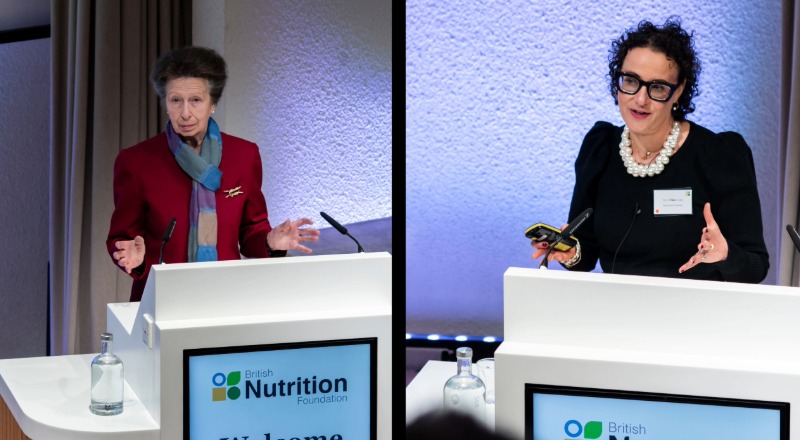
This in-person event, which was also live streamed, brought together academics, policymakers, and practitioners to tackle one of the most pressing public health challenges of our time, improving the diets of children and young people.
Children’s health and children’s diets are hugely important. Yet, rising rates of obesity, food insecurity, and exposure to unhealthy food environments challenge the ability to have affordable and healthy food.
This conference explored both the challenges and solutions, offering evidence-based insights and practical strategies.
I spoke in the morning session alongside my colleagues Professor Maria Bryant (York University) and Professor Greta Defeyter (Northumbria University). A great representation of Northern University academics.
Our morning session had a very special guest in the audience, Patron of the British Nutrition Foundation, Her Royal Highness The Princess Royal. Earlier the speakers were invited to meet The Princess Royal and individually talk to her about our work. A good ear for accents, Her Royal Highness. quickly recognised I wasn’t a Teesside native. (Those who know me will be aware that I am from Northern Ireland, and I very much sound like I am).
My talk was titled “Unpacking the Food Environment: Implications for Children and Families” and I discussed Healthy Planning and was able to introduce the audience not just to our academic evidence but also our evidence informed free online training on the topic aimed both at public health and planning teams in local authorities.
I presented our recent ‘Dark Kitchens’ research. The rise of online meal delivery and “dark kitchens” is reshaping how families access food, increasing exposure to calorie-dense options at the click of a button and increasing the availability of accessibility of less-healthy food choices.
Improving dietary health isn’t simply about individual choice—it’s about transforming the food environments in which those choices are made.
While planning allows us to shape our food environment there is much we can do around food retail to create healthier food environments. I discussed some findings from our NIHR School of Public health Research Funded Foodscape study.
We cannot describe the food environment without acknowledging that many households face significant barriers to accessing affordable, healthy food, with direct consequences for children’s health and wellbeing. Food insecurity is real and affects families across the UK. At Teesside, we have worked with communities and organisations using innovative methods to produce healthy food within local social supermarkets such as our healthy ready meal.
I called for stronger planning policies and interventions to create healthier food environments, emphasising the importance of collaboration between communities, professionals within local authorities, government and industry.
Improving dietary health isn’t simply about individual choice—it’s about transforming the food environments in which those choices are made.
Her Royal Highness The Princess Royal has been patron of the British Nutrition Foundation since 1988 and delivered a powerful speech at the conference, emphasising the importance of food in society and within education. Her remarks reinforced the British Nutrition Foundation’s mission to ensure every family can access a healthy, sustainable diets.
The conference show-cased many impactful speakers and left us with the key message that Nourishing our tomorrow, needs to start today.
Latest articles
 Nourishing Tomorrow: my insights from the British Nutrition
...
Nourishing Tomorrow: my insights from the British Nutrition
... International acclaim for film celebrating region’s mining
...
International acclaim for film celebrating region’s mining
... Funding for research project to help reduce health
...
Funding for research project to help reduce health
...Most read
- Teesside University crowned as Modern University of the Year 2026
- Teesside University shortlisted for prestigious University of the Year award
- Teesside University Vice-Chancellor Professor Paul Croney OBE announces retirement
- Teesside University leads global student innovation in international hackathon
- International partnership to drive net zero innovation