Lesbian Visibility Week – pick up a book
To mark lesbian visibility week (20 -26 April), the LGBTQ+ focus group has indulged their love of books with a selection of recommendations to help people find lesbian stories across a range of genres. Reading books with characters we can identify with leaves a more powerful imprint on our minds and emotions, making the experience far more meaningful.
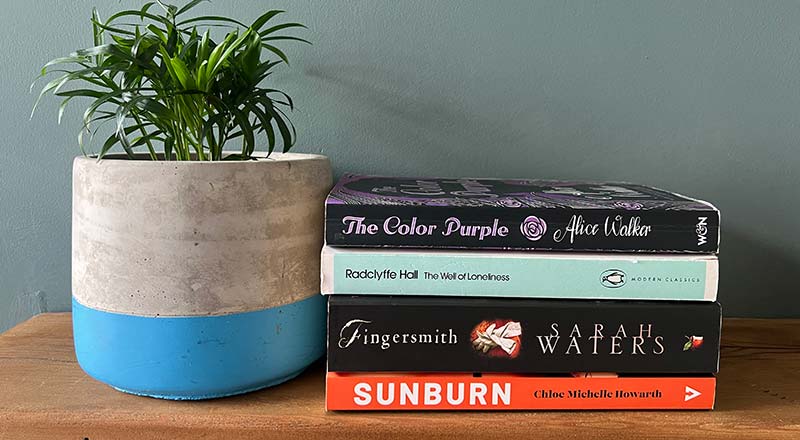
Throughout history, books such as The Well of Loneliness by Radcliffe Hall (1928) were banned. Its production and sale in the UK were prohibited from 1929 until 1959 because it tells the story of a woman falling in love with another woman. Higher authorities viewed this as obscene and sought it to have it banned.
At that time, same-sex love was mainly only pathologised in scientific texts and had rarely been openly written about in novels. Hall stated that she wrote this book as a plea for tolerance. The author died in 1943 and did not live to see the impact or lasting controversy the novel would generate over nearly 100 years on. It continues to be debated and discussed just as fervently today as it was upon its initial release.
This book is one of the earliest texts to offer insight into what is now understood to be gender dysphoria. The main female character, a woman named Stephen, expresses her masculine qualities and prefers to present as male. This narrative was ahead of its time, addressing concepts of gender identity long before modern vocabulary existed to describe such experiences. It helps us to gain a better understanding of the struggles women faced and ways in which they disguised their love for one another. However, it offers a narrow perspective on lesbian experiences during this period. The realities for women of lower social status were markedly different, as they often faced misogyny alongside multiple forms of prejudice.
Books by black female authors, such as The Colour Purple by Alice Walker, provide a much darker depiction of the lived experiences of women who suffered under patriarchy, racism and class oppression. The LGBTQ+ element of this story capture diverse ways of loving and being loved, even in the absence of supportive language or social frameworks.
Also very much worth a read . . .
Crier’s War by Nina Varela A fantasy/sci-fi story set in a world where an android monarchy rules over humans, following the romance between an android princess and a human servant. A highly recommend queer representation in the fantasy and sci-fi genre, full of political intrigue and amazing world building.
Reading books with characters we can identify with leaves a more powerful imprint on our minds and emotions, making the experience far more meaningful.
Sunburn by Chloe Michelle Howarth A tender, beautifully written coming of age story about the love between Lucy and Susannah, set in a small Irish town, exploring themes of self-acceptance, mother-daughter relationships, and religion along the way.
Untamed by Glennon Doyle A powerful read about breaking free from societal expectations and learning to trust your true self. Through honest and personal stories (including her journey of falling in love with a woman) it explores identity, courage, and what it means to live authentically.
The Gilda Stories by Jewelle Gomez This follows the experiences of a black lesbian vampire through different time periods and mixes historical and speculative fiction.
Fingersmith by Sarah Waters A neo-Victorian twisty tale of two women who fall in love and thwart the plans of a man wanting to defraud one of them. This mixes Dickensian crime drama and queer psychological thriller elements.
How it Works Out by Myriam Lacroix This genre-bending lesbian novel explores lots of different hypothetical trajectories for the central couple. It's gripping, funny, horrific, romantic, and everything in between.
The Safekeep by Yael van der Wouden A beautifully rendered post-war novel about repression, longing, and self-discovery.
Ordinary Saints by Niamh Ni Mhaoileoin While the central story focusses on Jay’s complex feelings about the campaign to make her late brother a saint, her sexuality is inextricably linked to her experience of Catholicism. She is in a relatively early stage of her relationship, and it’s beautiful to see how the two women tentatively navigate supporting each other through old wounds.
Latest articles
 Teesside University recognised with two national awards for
...
Teesside University recognised with two national awards for
... Next round for the Pint of Science festival
  Tees Valley at the centre of multimillion-pound clean energy
...
Tees Valley at the centre of multimillion-pound clean energy
...Most read
- Teesside University wins prestigious University of the Year award
- Teesside University appoints next Vice-Chancellor and Chief Executive
- Teesside University professor named among UK’s top tech women
- Groundbreaking Knowledge Transfer Partnership converts construction waste into green economic solutions
- Poor health in the North costing the UK billions in lost productivity