Teesside University research calls for clearer policy to secure fair hydrogen transition
Experts at Teesside University are urging government and industry to provide clearer direction and stronger regional focus to ensure the UK’s hydrogen economy delivers long-term benefits for communities and businesses.
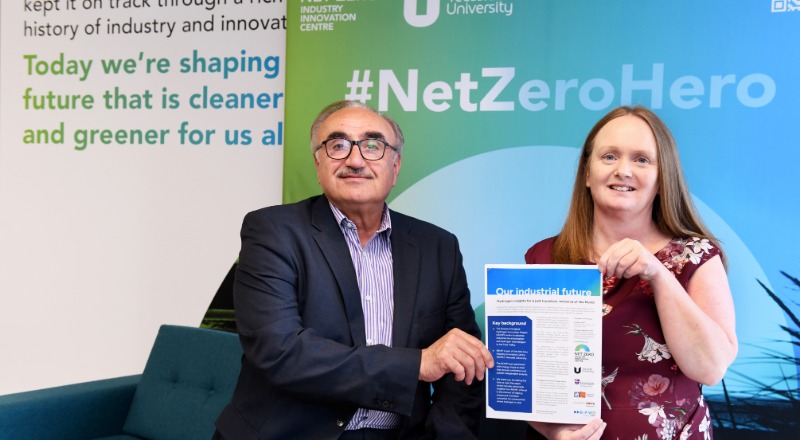
The call comes in a new whitepaper, 'Hydrogen Insights for a Just Transition', co-produced by Teesside University and sector publication Energy Voice, drawing on research from the Research England Hydrogen Innovation Project (REHIP).
The publication sets out how the UK can translate hydrogen ambition into practical, inclusive outcomes, particularly in industrial regions such as Teesside, where hydrogen will play a central role in achieving net zero.
The whitepaper has been published ahead of the UK Government’s hydrogen strategy refresh and will be shared with policymakers, including MPs and civil servants, as part of ongoing engagement to inform national decision-making.
It forms part of wider efforts by Teesside University to ensure its research contributes to real-world impact, supporting evidence for national policy development and future REF submissions.
The paper identifies five key areas where urgent action is needed:
- Providing clear, long-term strategic direction for hydrogen development
- Stabilising demand to unlock investment and reduce risk
- Embedding skills and workforce development as core infrastructure
- Supporting SMEs and strengthening supply chains
- Delivering a place-based approach that reflects regional needs
These recommendations highlight the need for coordinated national policy alongside locally targeted implementation to ensure economic and social benefits are widely shared.
The research highlights Teesside’s pivotal role in the UK’s hydrogen economy, while also warning that continued policy uncertainty is already affecting businesses, skills pipelines, and investment decisions across the region.
Evidence from REHIP shows companies are delaying recruitment and training, and in some cases making redundancies, due to uncertainty surrounding large-scale hydrogen projects.
The paper also identifies risks to regional supply chains, particularly SMEs, which are less able to absorb uncertainty and may be excluded from future opportunities without targeted support.
Through innovative research and collaboration, the project aims to develop solutions that will make the transition to a hydrogen-based economy more just, efficient, cost-effective, and safe.
Alongside economic challenges, the whitepaper stresses the importance of public trust and community engagement in delivering a successful transition.
It finds that acceptance of hydrogen technologies is shaped not only by environmental benefits, but also by concerns around safety, fairness, governance, and long-term impacts on communities.
The authors argue that a “just transition” must go beyond high-level ambition, requiring early and visible benefits, meaningful community involvement, and long-term investment in local capabilities.
The whitepaper is led by Professor Matthew Cotton, Professor of Environmental Justice and Policy, with Dr Clair Cooper, Research Fellow in Just Transitions at Teesside University.
Professor Nashwan Dawood, Principal Investigator of REHIP at Teesside University, said: 'Hydrogen, as an energy carrier, should be one of the key drivers of the UK’s future energy security.
'The Teesside industrial cluster is responsible for around 50% of the UK’s hydrogen production capacity, and this contribution is expected to grow further if government, industry, and local communities work together to support progressive policies and strategic investment.
'The REHIP research project is well-positioned to address the challenges associated with hydrogen production, transportation, storage, and end use.
'Through innovative research and collaboration, the project aims to develop solutions that will make the transition to a hydrogen-based economy more just, efficient, cost-effective, and safe.'
The publication also draws on insights from the REHIP annual industry conference, which brought together leaders from across academia, industry, and policy to explore the opportunities and challenges facing the sector.
Teesside University researchers will continue to engage directly with policymakers, including through upcoming national events, to ensure that regional perspectives are reflected in the UK’s hydrogen strategy.
Latest articles
 Landmark partnership will strengthen UK defence capability
 Teesside University research calls for clearer policy to
...
Teesside University research calls for clearer policy to
... Teesside University honours for esteemed trio
 Most read
- Steph McGovern launches new Teesside University scholarship to support women in engineering
- Vice-Chancellor honoured with Inspirational Leader Award
- Tees Valley at the centre of multimillion-pound clean energy programme shaped by Teesside University
- Movie visual effects Oscar nomination for Teesside University graduate
- New report showcases transformative support for students