Course overview
It is a natural progression route for holders of a QCF Level 5 Higher National Diploma or equivalent qualification in a related discipline.
Modules include industrial electrical and electronic systems, power systems and drives, sustainability and Industry 4.0. Your degree can be decided following discussion between you and your online project supervisor, enabling you to focus on an area of particular interest to you.
You study via distance learning using Teesside University’s online learning platform which means you can easily fit your studies around work and other personal commitments.
Top reasons to study electrical and electronic engineering with Teesside:
- Flexible learning: delivered fully online, you can study flexibly from anywhere in the world, making it ideal for working professionals or those with other commitments.
- Industry-relevant curriculum: cover areas such as power systems, industrial electronics and renewable energy, aligning with current and future industry needs.
- Supportive environment: benefit from strong academic support including access to tutors, online resources and a collaborative online student community.
Online learning
Online learning allows you to get a university-level qualification from the comfort of your own home or workplace. You'll have access to all of the world-class teaching and support that Teesside University has to offer, but all of your lectures, tutorials and assessments will take place online.
Find out more about Online learning
Course details
Course structure
Core modules
This module aims to provide you with the capability to design and analyse electrical power circuits and systems. You learn a broad range of topics related to generation and conversion of electrical power.
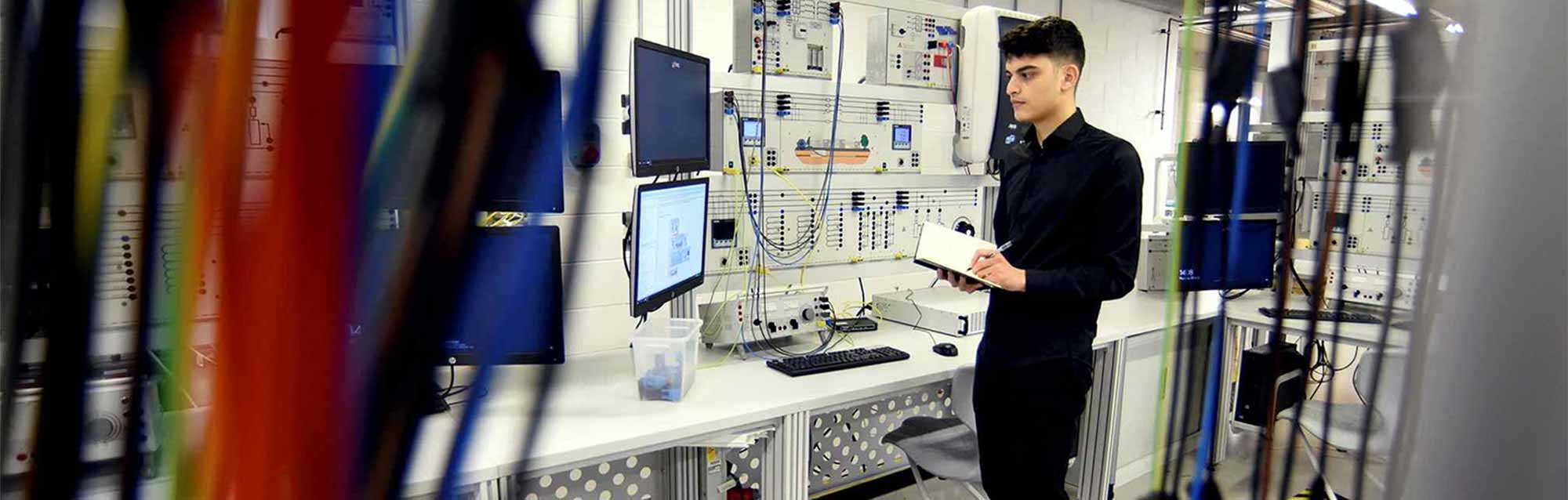
The module is delivered through a combination of lectures, guided reading, laboratory sessions and tutorials. Extensive use of modern experimental facilities will give you the opportunity to explore electrical power systems and to gain a deep understanding of practical constraints.
Power Electronics and Drive Systems
You develop the skills to analyse and design power electronic converters and to integrate them in electric drive systems.
The module is delivered through a combination of lectures and tutorials including guided exercises. There is also a series of practical classes that reinforce the theory and demonstrate the dependence of the drive system performance on the characteristics of the power converter and the control scheme employed.
This module advances the development of your independent learning skills by allowing you to investigate an area of engineering for an extended period. You are given training in writing technical reports for knowledgeable readers and you produce a report or dissertation of the work covered. You also give an oral presentation, a poster presentation or both. The topic can be in the form of a research project or a design project. You develop key skills in research, knowledge application and creation through keynote lectures where appropriate and self-managed independent study. You are supported through regular tutorial sessions and project supervision meetings.
Renewable Energy and Low Carbon Systems
The demand for energy – to run electrical devices, heat and cool buildings, and maintain industry – continues to grow and places considerable strain on the natural environment. The pressures of supporting economic growth, while seeking to minimise our environmental impact, has driven the research and development of new sources of energy.
You gain the knowledge and skills to implement suitable alternative energy technologies and understand their economic, social and environmental benefits within a broader context.
You cover energy systems, solar power systems, energy conservation, passive solar heating, wind energy, ocean energy technologies, hydro and micro-hydro turbines, geothermal energy, air pollution abatement, carbon dioxide sequestration and carbon trading economics.
Sustainable Systems and Industry 4.0
The emergence of Industry 4.0, often referred to as the fourth industrial revolution, has been attributed to advancing automation, decentralisation and system integration and cloud computing. In the cyber-physical environment, machines can communicate, collect information, and make informed decisions through artificial intelligence (AI), big data and industrial internet of things (IIoT). The evolution of Industry 4.0 has great potential to improve the energy, equipment, and human behaviour. At the same time, in the era of the so-called circular economy, industry across all sectors is under huge pressure to make their manufacturing operations ethical and sustainable. Therefore, we must learn to adopt or implement the latest Industry 4.0 technologies.
The term sustainability has a multi-disciplinary use and meaning. As future engineers you will learn sustainability is represented as the synergy between environment, economics, and society. In this module students specialising in Sustainable Systems and Industry 4.0 will focus their studies and deepen their knowledge in a range of sustainability themes such as energy management and power systems, sustainable water and wastewater systems, sustainable transportation technologies, transitions to sustainable food systems and mechanical manufacturing systems.
The subjects will be taught through a combination of lectures and seminars. Lectures will develop key concepts and knowledge. Seminars will allow more focused examinations of important issues and approaches
Modules offered may vary.
How you learn
You learn through pre-recorded and online seminars. If you are unable to attend online, a recording will be available for you. This gives you flexibility to manage study time around your personal and work commitments.
Your self-directed learning time is used to review lecture notes, prepare course work assignments, work on projects and revise for examinations.
Lectures prepare you with the relevant theory and concepts for independent learning. Online seminars provide a context for interactive learning. Online practical sessions allow you to explore industry-standard software packages for digital design, modelling and simulation of engineering systems.
How you are assessed
Assessment methods include examination and in-course assessment with some utilising other approaches such as project-work or verbal and poster presentations.
Our Disability Services team provide an inclusive and empowering learning environment and have specialist staff to support disabled students access any additional tailored resources needed. If you have a specific learning difficulty, mental health condition, autism, sensory impairment, chronic health condition or any other disability please contact a Disability Services as early as possible.
Find out more about our disability services
Find out more about financial support
Find out more about our course related costs
Entry requirements
Entry requirements
A Level 5 qualification such as a Higher National Diploma (HND) or Diploma in higher education (DipHE) in a closely related discipline.
A Level 5 is the equivalent of the first two years of a three year bachelors degree.
International students must also provide evidence of English language skills equivalent to IELTS 6.0 with no less than 5.5 in each component. International students should also read the information on our international pages.
For general information please see our overview of entry requirements.
We welcome applications from international students. If you are applying from outside the UK, you can find detailed guidance on the qualifications we accept, entry requirements for your country, and how to apply on our international country pages.
Employability
Career opportunities
Graduate engineers can seek employment in almost every sector of industry, including automotive, aerospace, manufacturing, marine, medical, rail, power, processing, chemical, oil and gas, and food production.
On successful completion of this degree with at least 2.2 honours there are several postgraduate master's programmes available at Teesside University for further study. These include masters courses in cognate subjects as well as in alternative subjects such as project management.
Learning platform
Our virtual learning environment (VLE) is the platform you use to access your online course
Teesside University online learning courses are delivered through the Brightspace Learning Environment.
Here are some of the benefits.
- You can use it on your smartphone, tablet and computer.
- And you can use it anytime, so that you can plan your learning to fit your own schedule.
- It's easy to use and navigate.
- Modules are set out by topics and themes. You can use the progress bar to understand where you are in your modules, and appreciate your achievements.
- We support you to become familiar with your VLE, helping you to start learning quickly.
- You get feedback, help and guidance from tutors throughout your course through the VLE, and you can ask questions at any time.
- Our tutors use a live activity feed to keep you updated about your course.
- You can create a student profile, collaborate with other students and take part in online discussion forums.