Course overview
Gain the practical skills, applied scientific expertise and leadership capabilities to make meaningful contributions to outdoor coaching and community-based leadership roles.
Integrating coaching, leadership and therapeutic application of outdoor activities, you benefit from a modern and applied curriculum in line with industry standards.
This course is the only two-year Foundation Degree in Outdoor Coaching and Leadership in the North of England, offering distinctive and accessible progression into the sector. The location provides access to high-quality outdoor environments, including the North York Moors, Pennine hills and river systems.
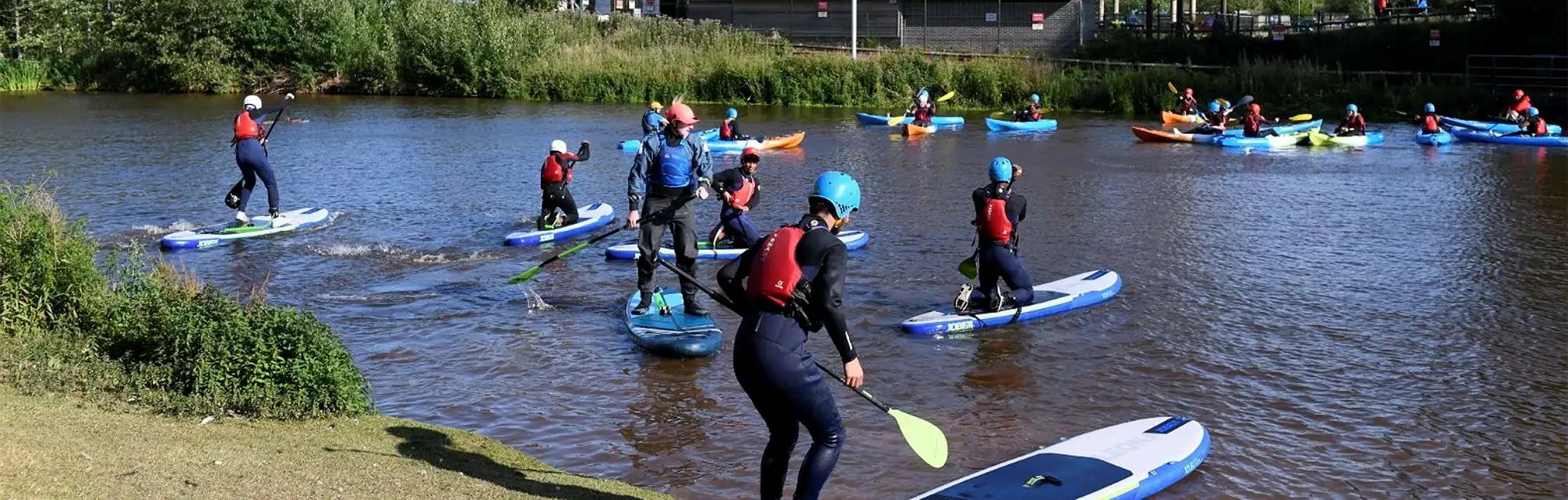
Built around industry engagement, you benefit from work experience, residentials and real-world delivery in professional environments. Residentials take place in locations such as the Lake District and North Wales, providing sustained exposure to authentic outdoor environments. Gain hands-on experience through paddlesport, land-based leadership and adventure therapy modules that mirror operational practice in outdoor centres. Controlled pressure environments, such as water-based activities and climbing, develop your resilience, confidence and self-awareness.
The curriculum integrates National Governing Body (NGB) expectations and offers opportunities to gain recognised awards such as Lowland Expedition Leader, Outdoor First Aid and Paddle UK qualifications, enhancing your employability and ensuring you meet professional technical and safety benchmarks.
This is a Teesside University award delivered in partnership with Darlington College. You study at Darlington College.
* Subject to University approval
Course details
Course structure
Year 1 core modules
Develop the essential personal techniques and fundamental coaching knowledge necessary for progression in the sheltered and moderate water environment. Experience kayak, canoe and stand-up-paddleboard disciplines, in line with the entry level qualification structure. Safety protocols and suitable profiling tools are introduced, along with a detailed examination of the historical and more recent coaching methods used within paddlesport.
Develop coaching skills in a practical outdoor and adventurous environment. Explore fundamental aspects of coaching theory, using current research while acknowledging links to historical studies.
This is a 40-credit module.
Develop the essential personal skills and foundational leadership knowledge for progression in hillwalking, navigation and introductory rock climbing environments. Gain experience in key technical areas, including map interpretation, route planning, movement on steep and uneven ground, and basic climbing and belaying techniques. Core safety principles, environmental considerations and participant profiling tools are introduced. Explore both the historical development of mountain leadership and the contemporary methods that shape current practice.
Understand how human physiology and biomechanics are vital to effective leadership and coaching as an outdoor professional. Gain physiological knowledge to anticipate and manage participants’ responses to environmental and physical stressors, such as prolonged exertion, thermal stress and fatigue. Develop biomechanical awareness to analyse and coach efficient movement patterns, including sports-specific techniques found in paddlesports, climbing and mountain biking. Learn to make informed decisions, tailor activities to individual capabilities, and create environments where safety, efficiency and high-quality performance are prioritised.
Reflective Research for Outdoor Practice
You are introduced to the core principles of research design and enquiry in outdoor leadership, with a focus on integrating sports coaching and sports science. Learn how to frame questions, select appropriate methods, collect and handle small data sets ethically, and communicate findings clearly to inform coaching practice.
You are introduced to key frameworks and practices that help outdoor leaders design, deliver and evaluate experiences that nurture physical, mental, emotional and social wellbeing in diverse participants and settings. Explore nature connection, green and blue exercise, adventure-based approaches, reflective practice, and trauma aware facilitation, linking theory to applied outdoor contexts. Engage with evidence-informed models, consider ethical and inclusive practice, and use reflective tools to understand your own wellbeing as leaders. The outdoor environment is positioned as an active co-facilitator of learning and change, aligning with sector expectations and professional standards, such as those of the Institute for Outdoor Learning. Learn practical strategies to support participant wellbeing while balancing risk-benefit judgement, safety and sustainability.
Year 2 core modules
Through theory, practical experience and reflective evaluation, you build professional skills employers value, such as ethical decision-making, dynamic risk assessment, inclusive facilitation and the ability to justify practice using evidence. Become better prepared for roles in outdoor leadership, adventure therapy, youth development and wellbeing-focused programmes.
Deepen your understanding of coaching science by focusing on the applied, context-specific and decision-making demands of outdoor coaching practice. Build on foundational theories from Year 1, developing your ability to integrate contemporary coaching frameworks with the unpredictable, dynamic and risk-laden environments of outdoor and adventure settings. Critically explore how advanced concepts such as ecological dynamics, constraints interaction, attentional regulation, motivation, experiential education and evidence-based coaching models inform real-world leadership behaviours. Emphasis is on the ability to analyse, justify, and adapt coaching strategies in response to changing environmental conditions, group dynamics and individual needs. Apply your theoretical knowledge to practical scenarios, coached sessions, observational analysis and reflective practice. Prepare for professional outdoor coaching roles by using research-informed judgement, demonstrating adaptive leadership, and applying coaching science principles to create safe, inclusive and developmentally rich outdoor learning environments.
Gain the technical competence, decision-making capability and self-reliance of emerging professionals in the outdoor sector. Expedition skills remain a core expectation across the industry, forming the foundation of safe practice, operational planning and professional judgement. Engage with realistic expedition planning, equipment selection, risk management and cultural considerations. Gain a practical and relevant understanding of contemporary expectations within leadership, guiding and outdoor education roles. Emphasis on autonomy mirrors industry practice where you must act confidently, ethically and responsibly in dynamic and unpredictable environments.
Alongside technical development, you are supported in personal growth through reflective practice, resilience-building and developing confidence in challenging conditions. Working in small groups develops your understanding of team dynamics, communication, conflict management and shared leadership qualities for effective expedition delivery and client-facing roles. The integration of digital reflective tools, scenario-based tasks and a student-led multiday expedition, enhances your employability, demonstrating transferable skills such as planning, collaboration, leadership, problem solving and self-evaluation. Prepare for progression into industry roles and national governing body pathways, gaining the competence, professionalism and adaptability expected of an outdoor leader.
Develop the entrepreneurial, financial, operational and marketing skills to create or contribute to successful outdoor businesses. Explore business formation, tax requirements, insurance, employer responsibilities and basic accounting processes. Gain an understanding of management and motivational theories to support effective planning and people management.
Advance from foundational coaching science towards evidence-informed, data-driven outdoor coaching and leadership. Design and conduct a small-scale action research project in an agreed outdoor setting such as adventure therapy, MTB, paddlesport, climbing or navigation. Collect authentic data (performance, behavioural, physiological, and/or survey responses) to evaluate and improve practice. Build coaching theory and application, studying the General Linear Models and applying intermediate statistical techniques, including parametric and non-parametric tests, and integrating survey design/analysis to inform decision-making in complex, variable environments.
Emphasis is on participant-centred, inclusive practice while adding strong analytical rigour, reflective cycles and professional standards aligned to outdoor sector expectations.
Develop advanced paddlesport skills and coaching techniques for effective leadership in sheltered and moderate water. Refine your kayak and canoe expertise while learning enhanced safety procedures and dynamic assessment skills. You are introduced to modern leadership and coaching methods, helping you apply confident, adaptable and evidence-informed coaching in more challenging conditions.
Modules offered may vary.
How you learn
Learning is shaped by the region’s exceptional outdoor resources and proximity to high-quality environments, providing an applied, practice-led curriculum that integrates classroom theory with authentic, real-world learning. You develop technical skills in kayaking, canoeing, navigation, climbing, and mountain biking through regular access to the Tees Valley, North York Moors, Pennines and local crags. Learning is complimented by residential experiences, reflective practice, and wellbeing-focused activities that build resilience, self-awareness, and leadership autonomy.
Structured indoor teaching builds scientific, coaching and leadership knowledge, including modules on sport science, pedagogy, adventure therapy and outdoor business, ensuring you can apply theory directly to field contexts. Industrial engagement is embedded through work placements, masterclasses, guest speakers and long-standing provider partnerships, providing exposure to vocational environments and enhancing your employability.
Each module is supported by the virtual learning environment (VLE). Throughout the course, a strong emphasis is on practical work, both lab and fieldwork-based, and other forms of experiential learning to develop essential knowledge, understanding and skills.
Learn from staff whose expertise spans master’s-level sport science, high-level NGB qualifications, and professional memberships such as CIMSPA, Paddle UK, and BMC, ensuring teaching is informed by best practice.
Benefit from a coherent, experiential and professionally aligned learning journey that prepares you to progress into skilled outdoor leadership roles or continue to the Teesside University top-up degree.
How you are assessed
You are assessed through a presentation, an exam/essay and a practical assessment each semester.
Our Disability Services team provide an inclusive and empowering learning environment and have specialist staff to support disabled students access any additional tailored resources needed. If you have a specific learning difficulty, mental health condition, autism, sensory impairment, chronic health condition or any other disability please contact a Disability Services as early as possible.
Find out more about our disability services
Find out more about financial support
Find out more about our course related costs
Entry requirements
Entry requirements
You should have 40-48 tariff points, or demonstrate your suitability for the course through:
- a Level 3 qualification (NVQ 3, BTEC Award, A level)
- appropriate training through work.
For general information please see our overview of entry requirements.
We cannot accept applications from international students requiring a student visa.
You can gain considerable knowledge from work, volunteering and life. Under recognition of prior learning (RPL) you may be awarded credit for this which can be credited towards the course you want to study.
Find out more about RPL
Employability
Career opportunities
This course opens a diverse range of career pathways across the outdoor education, adventure tourism, health and wellbeing, youth development and environmental sectors. Throughout your studies, you develop strong technical skills, applied scientific understanding, leadership capability and professional behaviours that are highly valued in outdoor and people-focused professions.
You can consider career options in:
- outdoor coaching and instruction
- education, youth work and community development
- adventure therapy, wellbeing and social impact roles
- outdoor leadership and operational roles
- freelance work and self-employment
- environmental, outdoor tourism and conservation sectors
- You may also consider further study progression.