Teesside University
GirlsWhoML: Building Inclusive AI in the Biosciences Community
Research and innovation
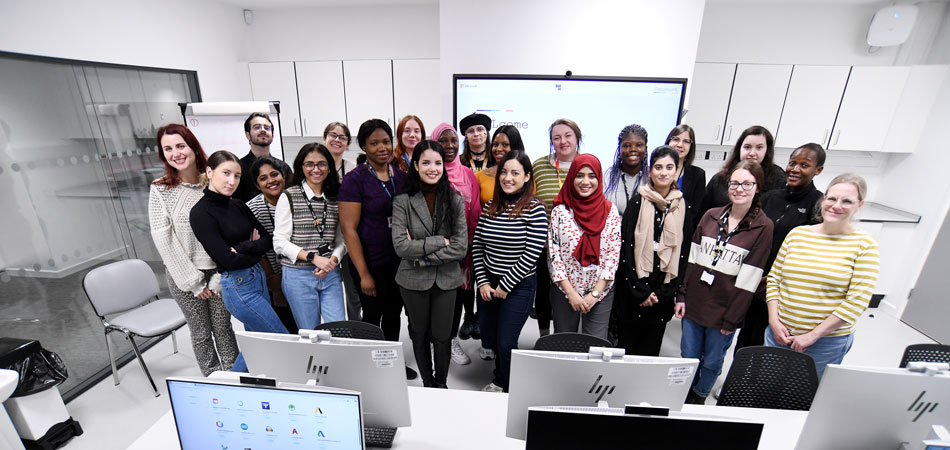
GirlsWhoML is a community-driven initiative that supports women and non-binary individuals entering the field of machine learning (ML) by providing an inclusive, supportive training environment. Hosted regularly at Teesside University, the programme is designed to build both technical skills and confidence, particularly for those at the beginning of their ML journey.
The workshops offer a two-day, hands-on introduction to computational and machine learning concepts, combining practical coding activities with opportunities to explore real-world applications of AI in the biosciences.
Challenge
Machine learning and AI remain areas where many learners – particularly women and non-binary individuals – face barriers to entry, including a lack of confidence, limited prior coding experience, and a shortage of inclusive learning spaces. There is a clear need for accessible training that allows participants to progress at their own pace, ask questions freely, and see how technical skills connect to meaningful scientific applications.
Solution
The GirlsWhoML workshop was designed to address these challenges through an inclusive, structured, and hands-on learning approach. The most recent event followed a carefully planned learning progression aligned with foundational machine learning concepts.
Day one began with an introduction to Python, covering variables, data types, packages and simple classes. Participants then worked through hands-on sessions using Jupyter Notebooks to implement linear and logistic regression models, supported by live coding demonstrations and workbook-based practical exercises.
Day two focused on neural networks, introducing key concepts such as input variables, hidden layers, activation functions, loss functions, optimisation techniques, and iterative model updates. Research presentations from academics and PhD students were embedded throughout the programme, enabling participants to connect technical learning with current applications of machine learning in the biosciences.
Impact
The workshop created an inclusive and supportive learning environment for participants with a wide range of coding and machine learning experience. The blended structure of demonstrations, guided practical work and collaborative learning enabled attendees to progress from basic programming skills to more advanced topics such as logistic regression and neural networks.
By integrating research presentations into the programme, participants were able to see how machine learning techniques are applied to real-world bioscience challenges. This strengthened knowledge exchange, encouraged confidence-building, and fostered a sense of community across the biosciences and AI disciplines.
The event was kindly sponsored by AIBIO-UK.
This type of event reflects our commitment to building an inclusive community around AI, providing opportunities for women and early career researchers to develop skills and confidence in AI.
Our goal was to create a space where participants could learn machine learning step by step, at their own pace, and with the confidence that support was always available. The structure of the two days reflects our commitment to making AI skills accessible and welcoming to everyone.
I found the workshop incredibly insightful – especially the practical exercises using Python to develop logistic regression models and simple neural networks in real time. It was both engaging and highly practical, and I would strongly recommend it to anyone looking to build confidence in ML and AI.