Daisy Chain
Collaborating on inclusive employment and environmental sustainability.
Research and innovation
Daisy Chain is a charity supporting more than 10,000 neurodivergent children, young people, adults and families across the North East and Yorkshire each year through specialist wellbeing, employability, family support and community inclusion services. Alongside its charitable activities, the organisation operates a range of social enterprises focused on reducing waste and creating meaningful opportunities for neurodivergent people.
One of Daisy Chain’s flagship innovation projects is Neuthread, a sustainable fashion and manufacturing initiative that transforms donated textiles into high-quality garments and products. Operating at the intersection of circular economy innovation, sustainable fashion and social impact, Neuthread became the first charity-led fashion brand to showcase at London Fashion Week. The organisation is also developing an eco-manufacturing facility in Stockton-on-Tees, designed to demonstrate how inclusive employment and environmental sustainability can work together.
Challenge
As Neuthread transitions from pilot activity into active manufacturing, retail and future e-commerce operations, the organisation identified a significant challenge around measuring the environmental impact of its products.
Unlike traditional manufacturers that work with standardised materials and supply chains, Neuthread uses donated and reclaimed textiles from a variety of sources. Individual garments can contain multiple fabric types and mixed fibres, making accurate carbon measurement particularly complex.
The organisation also needed any solution to work within a live manufacturing environment. Data collection processes had to be simple and practical for production teams to use without disrupting workflow, slowing output or creating excessive administration. At the same time, the approach needed to be scalable as the operation grows and capable of supporting transparent sustainability reporting for customers and stakeholders.
Solution
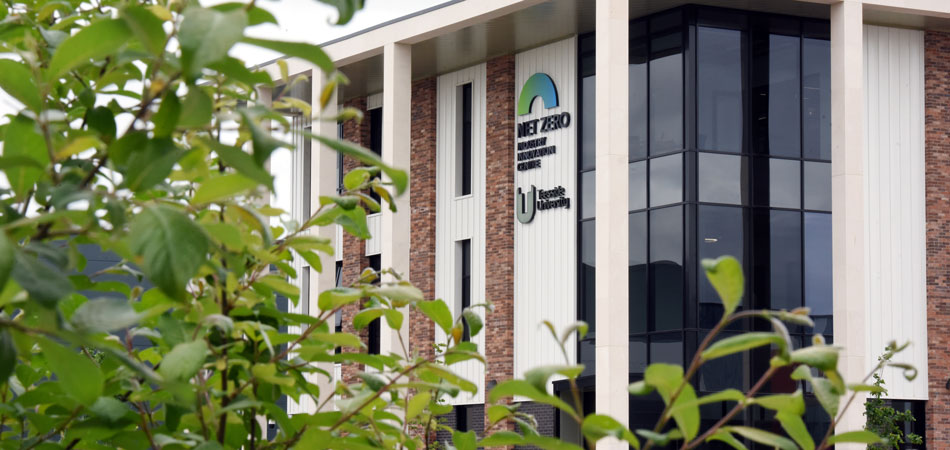
To address these challenges, Neuthread partnered with the Teesside University Net Zero Industry Innovation Centre to develop what is believed to be a first-of-its-kind AI-powered carbon tracking system for circular fashion manufacturing.
The project is exploring how Large Language Model (LLM) technology can be used to simplify the collection, management and analysis of complex sustainability data. Working closely with the Neuthread team, specialists from Teesside University have taken a collaborative approach to understanding the realities of the organisation’s manufacturing model rather than applying traditional manufacturing assumptions.
The partnership has focused on mapping how donated textiles move through the production process, exploring fibre complexity within mixed-material garments, and testing how environmental data can be captured without disrupting day-to-day operations. A key objective is to develop a practical, user-friendly system that production staff can use in real time while creating robust environmental reporting capabilities.
Alongside internal carbon measurement, the project is also exploring how sustainability data can be communicated directly to customers, enabling greater transparency around the environmental impact of individual products.
Impact
While the project remains in development, the collaboration has already delivered significant value. It has established the foundations for a potentially groundbreaking approach to carbon measurement within circular fashion manufacturing and increased Neuthread’s understanding of AI-supported environmental tracking and reporting.
The partnership has helped create a framework for integrating sustainability data collection into live production environments, while strengthening the organisation’s confidence in its ability to measure and communicate environmental impact as it scales. It has also enhanced innovation capacity within the organisation and opened opportunities for future research and development activity.
The project is helping position Neuthread as an innovation-led initiative operating at the intersection of sustainability, AI, manufacturing and inclusion. By developing new ways to evidence environmental impact in a transparent and accessible way, the organisation is building foundations for stronger customer trust, more effective sustainability reporting and wider influence within the circular fashion sector. As a result, the partnership is not only supporting Neuthread’s growth but also contributing to wider conversations about how AI can help address sustainability challenges within complex manufacturing systems.