Course overview
This course has been specifically designed to facilitate further learning for those involved in, or have aspirations of a career in, the field of electrical power engineering including the renewable energy systems sector.
The course aims to deepen the students’ knowledge of subject areas previously studied as part of their first degree (i.e. electrical engineering). The course is built around two discipline specific specialist threads and one future facing thread. The course comprises five 20 credit subject specialist modules covered in these threads.
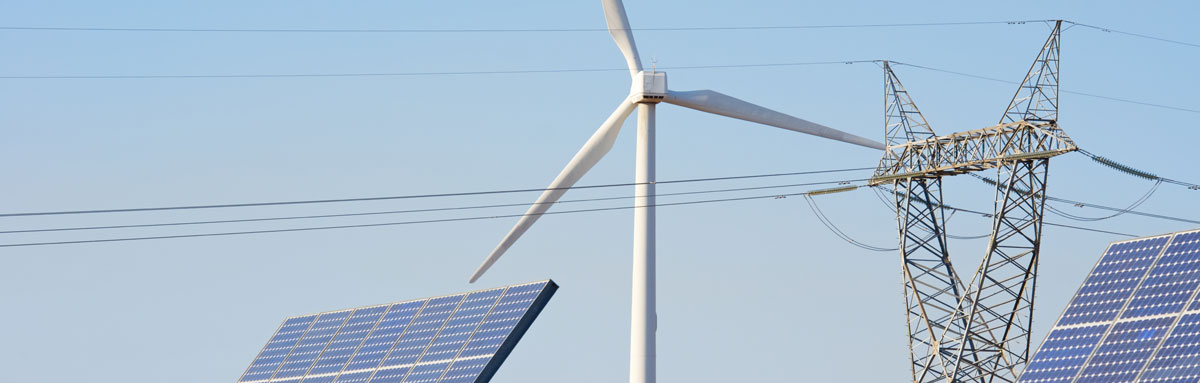
 The specialist threads are electrical power networks (comprising: Smart Grids, Microgrids, Future Energy Demand) and power electronic applications (comprising: Renewable Energy Generation, Power Conversion for Energy Systems). These specialist threads have been chosen to provide employment opportunities in a wide range of industries especially in the electrical power engineering sector, but additionally electrical power system skills for related renewable energy industries.
Course details
Course structure
Core modules
Undertake an independent research project addressing a real-world sustainability or clean energy challenge. This project enables you to apply advanced research methods, technical analysis, and critical evaluation to produce industry-relevant solutions.
Examine global and regional energy demand trends, energy modelling, electrification, smart grids, and the challenges associated with balancing supply and demand in a low-carbon economy.
The microgrid is taught as an application to optimise renewable generation using energy storage systems to meet demand. Mathematical modelling of systems based power flow is demonstrated, integrated with renewable generators, power conversion and load controllers. Computer software to develop models to optimise the generation, and integrate it in the microgrid context using demand side management and storage. Microgrid planning and design forecasting demand, energy management, provision of ancillary services, Operation and control of Microgrids, Microgrid protection, and case studies are used to illustrate and assess the module.
Power Conversion for Energy Systems
The module provides students with an in-depth knowledge of Power Electronic converters as they are used on power systems to allow efficient transmission of power from generator to consumer. The modules will teach about the operation and design of the main converters and their applications. It provides a generic treatment of various converter topologies with an emphasis on critical design parameters. Applications including HV DC transmission, static VAr compensation and interconnection of renewable energy sources and energy storage systems to utility grid are considered.
Study renewable technologies such as solar, wind, hydro, and emerging systems, alongside energy storage, grid integration, and performance optimisation.
The module provides students with an in-depth knowledge of the principles of operation, design and utilisation of smart grids to optimise the transmission and distribution of power. It provides a generic treatment of various power system topologies with an emphasis on critical design parameters at distribution level and the evolution to the wider transmission network. The impact on existing networks and future developmental opportunities are considered alongside automation and control requirements. The module will also inform the students of recent technological advances in the field of electrical power transmission and will provide an opportunity to develop practical skills related to this area.
Explore the principles of sustainability within engineering practice, including environmental impact assessment, systems thinking, climate change mitigation, and policy frameworks supporting sustainable development.
Modules offered may vary.
How you learn
You learn through lectures, seminars and practical sessions. Lectures provide the theoretical underpinning while practical sessions give you the opportunity to put theory into practice, applying your knowledge to specific problems. Industry specific software is introduced and used in practical IT labs to ensure the relevant experience for career goals.
Seminars provide a context for interactive learning and allow you to explore relevant topics in depth. In addition to the taught sessions, you undertake a substantive MSc research project.
How you are assessed
Assessment varies from module to module. The assessment methodology could include in-course assignments, design exercises, technical reports, presentations or formal examinations. For your MSc project you prepare a dissertation.
Entry requirements
You must have a second class (2.2) honours degree (or higher). We consider a wide range of first degree subjects including automation and control engineering, electrical and electronic engineering, electrical engineering, electrical systems, electronic engineering, electronic systems, instrumentation/control engineering, mechatronics, and robotics.
Students with a degree awarded outside the UK must also meet the University's minimum English language requirements.
International applicants who need a student visa to study in the UK should check our web pages on UKVI-compliant English language requirements. The University also provides pre-sessional English language courses if you do not meet the minimum English language requirement.
For general information please see our overview of entry requirements
International applicants can find out what qualifications they need by visiting our international country pages.
Employability
Career opportunities
As an electrical power and energy systems engineer you can be involved in designing, constructing, commissioning and lifecycle maintenance of complex energy generation, conversion and distribution systems.
Your work could include energy storage systems, control systems, management and efficient use of energy in building, manufacturing and processing systems. You could also be involved in work relating to the environmental and economic impact of energy usage.
Examples of the types of jobs you could be doing include:
- designing new electrical transmission and distribution systems
- managing maintenance and repair
- managing operations of existing systems
- managing operations of a wind turbine farm
- analysing the efficiency of hydroelectric power systems
- evaluating the economic viability of new solar power installations
- assessing the environmental impact of energy systems.
Information for international applicants
Qualifications
International applicants - find out what qualifications you need by selecting your country below.
Select your country:
Useful information
Visit our international pages for useful information for non-UK students and applicants.