Course overview
Accredited Foundation year Integrated masters Work placement
Mechanical engineers design and manufacture anything that has moving parts, from automotive transmissions to prosthetic devices, gas turbines, wind turbines, robots and machine tools.
You gain knowledge and understanding of mechanical engineering subjects including mechanics, dynamics, fluids, thermodynamics, materials, digital engineering, computer-aided-design, electrical principles, finite element analysis, manufacturing, product development and assembly line modelling.
Top reasons to study mechanical engineering here:
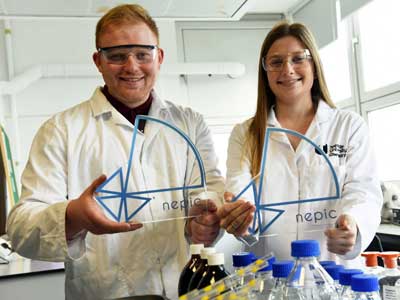
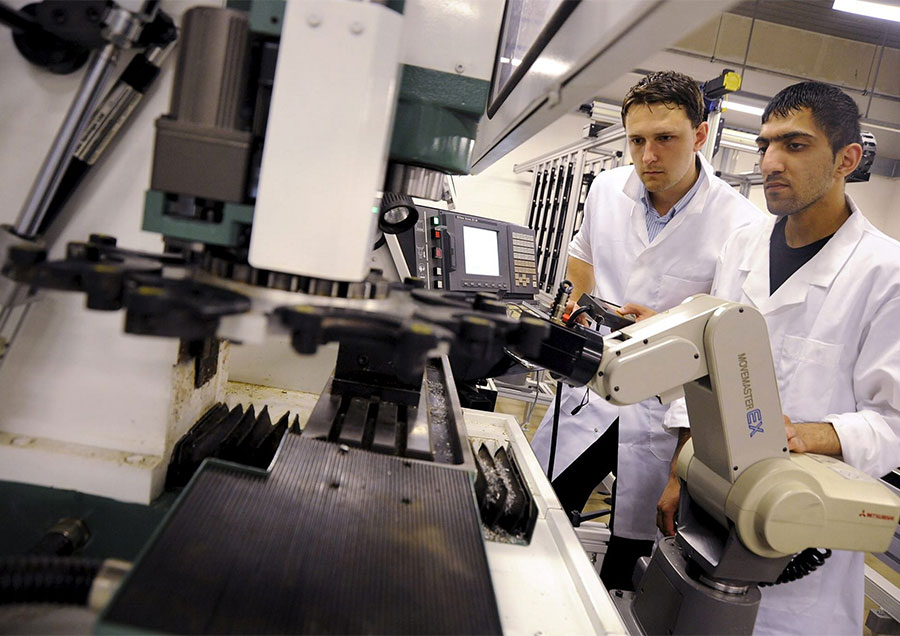
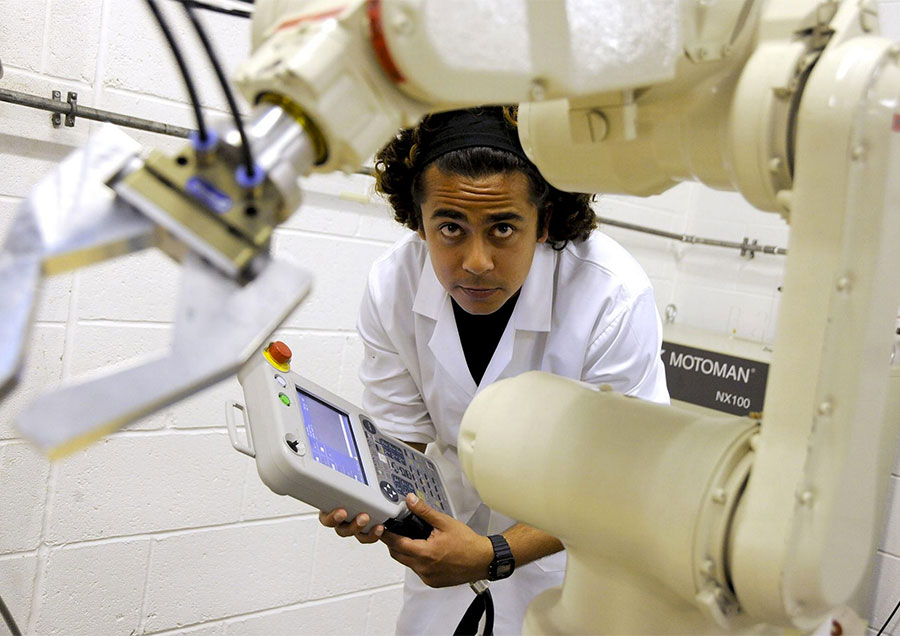
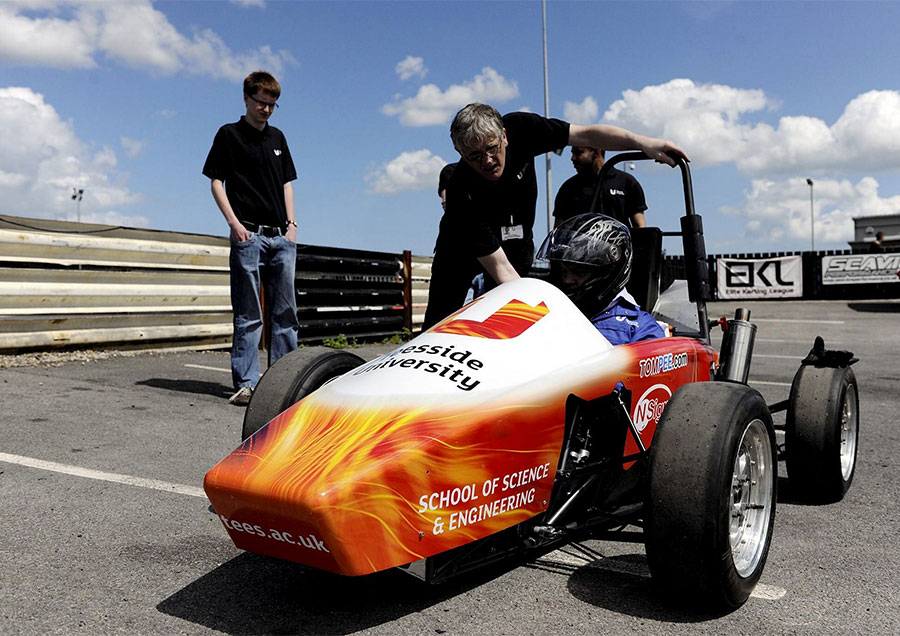
- Practical learning: get involved with our hands on approach to teaching through lab work, site visits and projects including the Design Challenge, Formula Student and Formula Student AI.
- Student satisfaction : Teesside University was ranked 1st for Student Satisfaction for Mechanical Engineering in the Complete University Guide 2025. (75 institutions were ranked, tees.ac.uk/source).
- Industry experience: get a foot on the career ladder and gain experience of working in the sector with an optional year in industry.
- Student satisfaction: 95.9% of mechanical engineering students agreed that their course has developed the knowledge and skills they think they will need for their future (National Student Survey 2024, tees.ac.uk/source).
- Graduate Success: 100% of BEng (Hons) Mechanical Engineering students go on to work and/or study 15 months after the course (Graduate Outcomes Survey 2020-21, tees.ac.uk/source).
- International visits: you have opportunities to travel internationally through student mobility visits or spending a semester studying abroad with one of our partners in countries such as China, the Czech Republic, Spain and Malaysia.
Course details
Course structure
Year 1 core modules
This module will introduce you to the fundamentals of electrical circuit theory and how to apply it to analyse simple electric circuits. The module will also introduce you to electromagnetic energy conversion and AC power.
The module is taught with lectures, seminars and related practical work. Your lectures will provide an explanation of principles and discussion of applications. Practical sessions will provide you an opportunity to develop practical skills through the use of laboratory setups that reinforce the lecture material.
This module introduces the range of mathematical skills that are relevant to an engineering degree. You revisit and develop your knowledge of the fundamentals of algebra, trigonometry and basic statistics. The central ideas of vectors, matrices, complex numbers, and differential and integral calculus are also examined.
Throughout the module you develop a range of mathematical skills and techniques fundamental to the solution of engineering problems. You also advance your skills in selecting and applying mathematical techniques.
This module is delivered through a combination of lectures and tutorial sessions.
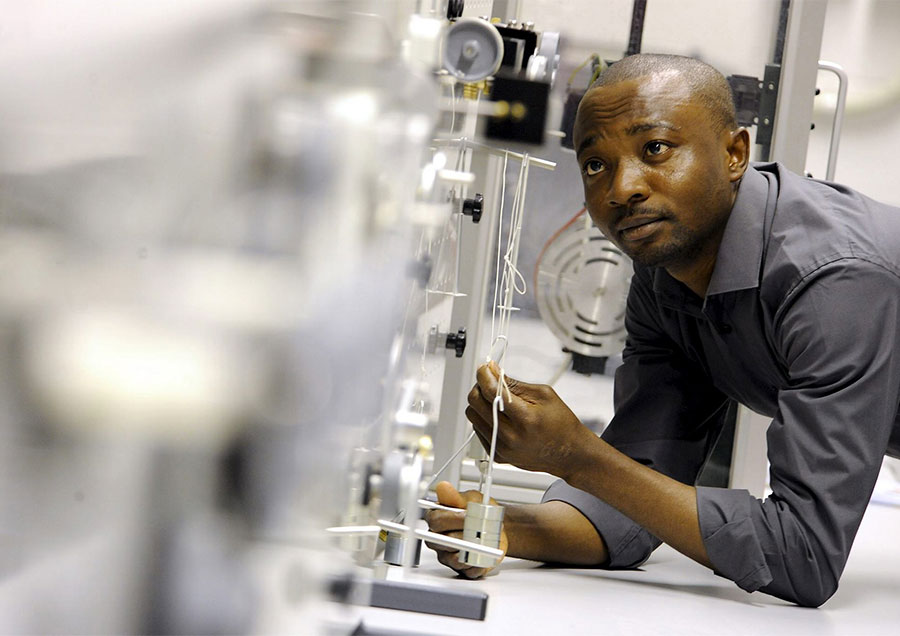
You look at engineering materials in lab-based practical sessions. Fundamental relationships between processing, structure, properties and performance are explored to highlight factors which influence the suitability of materials for various engineering applications.
Mechanical Engineering Practice
You develop and enhance the practical, professional and mechanical engineering skills necessary for success in both the academic and work environment. This practically-focused module enables you to develop your knowledge, confidence and practical skills. You also look at creating an engineered design and the organisational issues of controlling a project.
This module introduces common types of structure used in engineering, assesses the types of loads they must resist and provides you with the analytical skills necessary to design the components that make up the structure.
Specific areas of study include: basic concepts of force, stress and strain; properties of materials and sections; analysis of frames, beams and columns; equilibrium conditions and statical determinacy; beam bending movement, shear force and deflection; and lightweight cables.
Lectures will introduce each major topic on the module with tutorials used to practise calculations. Laboratory practicals are used to investigate the properties of construction materials and develop a deeper understanding of structural theory.
The module is assessed by in-course assignment and an examination, comprising calculations and short answer questions on the module indicative content.
This module introduces the student to the basic principles of fluid mechanics, properties of fluids, hydrostatics, continuity equation, Bernoulli's equation, flow measurements, real flow in pipes, friction losses and momentum equation. It deals with the transfer of heat, energy for solids, liquids and gases. It explores the various mechanisms for this heat transfer and laws of thermodynamics, quantifies these mechanisms and applies them to mechanical systems, principally engines and compressors.
Year 2 core modules
Aeroengines and Rocket Science
You look at the fundamental thermodynamics and operational characteristics of a range of engines and their components including gas turbines, jet engines, turbofans, turboshaft engines, ramjets, scramjets and rockets (which are used in aerospace applications) and torque power producing gas turbines (used in industrial and marine applications).
You explore the fundamental thermodynamics of engine operation, the equation for thrust calculations, Mach number, stagnation properties, shock waves, steady one dimensional flow, and analyses of flows through convergent and convergent-divergent nozzles. You learn how to calculate the performance and efficiencies of the engine and its components.
Components include burners and afterburners, compressors, turbine and nozzles. You also look at the calculation and analyses of flows through compressor and turbine blading stages, and fundamentals of rocket propulsion, trajectory analysis, and performance of solid and liquid rocket engines.
You attend a series of keynote lectures as well as problem-solving tutorials and practical investigations.
You develop mathematical knowledge in differential equations and numerical methods and extend your base of techniques to solve a variety of problems which arise in engineering domains. The emphasis is on developing competence in the identification of the most appropriate method to solve a given problem and its subsequent application.
Group Design and Build Project
This is a group project module which is part of the group project theme running through the engineering programmes.
This module will provide you with the opportunity to work in teams in order to solve industrially relevant design problems. In the course of this module, you will develop employability skills such as project management, presentation of work, research and commercial awareness, all of which support problem solving in a technical context.
You learn to use theoretical principles in the practice of creating an engineered design item, through group working activities. A problem based learning approach is adopted and where appropriate, supporting lectures/ seminars will be delivered to include technical knowledge or skills development.
You are assessed through two in-course assignments.
This module provides you with an insight into current manufacturing processes, promoting a deep understanding of technological factors and an awareness of working principles and capabilities. Traditional methods, such as casting and rolling are examined, together with state-of-the-art practices, such as powder metallurgy. You combine a detailed study of selected manufacturing processes with hands-on experience in laboratory-based practical sessions.
You review important aspects of current thinking, such as quality, reliability, sustainability, lean manufacturing and the extensive use of computers in many areas, to ensure an informed picture of modern manufacturing. You also explore the suitability of manufacturing processes for applications, using a framework that recognises the interrelationships of (manufacturing) process, (artefact) function, shape, and materials.
Mechanics of Materials is a branch of mechanics that studies the relationships between the external loads applied to a deformable body and the intensity of internal forces acting within the body. The subject also involves calculating the deformations of the body, and it provided a study of the body’s stability when the body is subjected to external loadings.
This module examines the essential theories and fundamental principles of mechanics of materials, and develops your knowledge, skills, and ability to apply them in mechanical analysis and design.
Product and Assembly Design Modelling
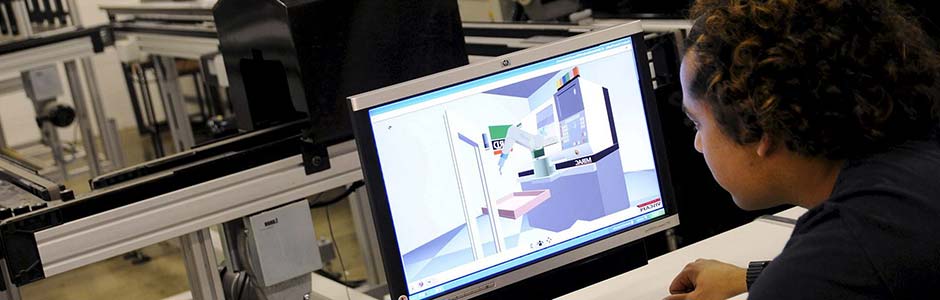
In this module, you develop your skills and knowledge in applying 3-D solid modelling and surface modelling to product design, using industry standard software. You gain a thorough understanding of computer modeling, and how to apply these skills to design engineering components and products.
You model parts with flat and cylindrical type surfaces, as well as those with more complex curved surfaces. The ability to obtain the mass and other properties of models and create orthographic drawings from 3D models will be covered.
You gain a thorough understanding of both static and dynamic hierarchical assemblies and their value to industry, and learn how to produce ‘Bill of Materials’, undertake clearance and interference checks on mating parts, and Tolerance Analysis.
You acquire the ability to animate dynamic assemblies; you create joints and mechanisms to solve for kinematic motions, and you learn how to structure the models effectively and modify them as appropriate.
Optional work placement year
You have the option to spend one year in industry learning and developing your skills. We encourage and support you with applying for a placement, job hunting and networking.
You gain experience favoured by graduate recruiters and develop your technical skillset. You also obtain the transferable skills required in any professional environment, including communication, negotiation, teamwork, leadership, organisation, confidence, self-reliance, problem-solving, being able to work under pressure, and commercial awareness.
Many employers view a placement as a year-long interview, therefore placements are increasingly becoming an essential part of an organisation's pre-selection strategy in their graduate recruitment process. Benefits include:
· improved job prospects
· enhanced employment skills and improved career progression opportunities
· a higher starting salary than your full-time counterparts
· a better degree classification
· a richer CV
· a year's salary before completing your degree
· experience of workplace culture
· the opportunity to design and base your final-year project within a working environment.
If you are unable to secure a work placement with an employer, then you simply continue on a course without the work placement.
Final-year core modules
Today engineers use computers and software in the engineering design and simulation of most of the products, processes and systems that make up our lifestyles. In this module your knowledge of advanced techniques is developed for the computer-based analysis of designs and to use commercial software to solve more complex engineering problems. You gain a thorough understanding of computer methods for the analysis of detailed design and are introduced to the finite element analysis (FEA) nodes, elements and meshing techniques. Types of boundary conditions such as loads and constraints are explained including how to apply them. You learn how to solve FEA problems and analyse the results. Advanced techniques utilising adaptive and optimisation methods for solving complex engineering problems is also covered.
Engineers design, develop, construct and test devices and systems which operate on basic principles of dynamics and vibration. The development of reliable systems depends on the engineer’s understanding of the response of the system to externally applied loads. The system’s response can be predicted using models that may be analytical, numerical or mathematical in nature. The analysis of physical systems to predict their responses to loads is fundamental to the study of engineering mechanics. Dynamics is a branch of mechanics that studies the properties and behaviours of objects in motion.
This module will develop the advanced theory and the principles of mechanics of materials and apply them to the analysis of realistic engineering problems. Specific areas of study include: stress concentrations, inelastic deformation and residual stress under axial loading, torsion, and bending as well as transverse shear. Further studies will include introduction to failure theory, design of beams and shafts, deflection of beams and shafts, design of column; thick-walled cylinder and interference fits.
Lectures will introduce each major topic on the module emphasising both the conceptual and theoretical development as well as their applications to realistic engineering problems. Worked examples will be used in the study. Seminars will be utilised primarily for students to practice and to provide feedback.
This module extends the development of independent learning skills by allowing you to investigate an area of engineering or technology for an extended period.
You receive training in writing technical reports for knowledgeable readers and you produce a report or dissertation of the work covered. In addition, you give an oral presentation, a poster presentation or both. The topic can be in the form of a research project or a design project.
You develop key skills in research, knowledge application and creation through keynote lectures where appropriate and self-managed independent study. Support is provided through regular tutorial sessions.
Sustainable Systems and Industry 4.0
The emergence of Industry 4.0, often referred to as the fourth industrial revolution, has been attributed to advancing automation, decentralisation and system integration and cloud computing. In the cyber-physical environment, machines can communicate, collect information, and make informed decisions through artificial intelligence (AI), big data and industrial internet of things (IIoT). The evolution of Industry 4.0 has great potential to improve the energy, equipment, and human behaviour. At the same time, in the era of the so-called circular economy, industry across all sectors is under huge pressure to make their manufacturing operations ethical and sustainable. Therefore, we must learn to adopt or implement the latest Industry 4.0 technologies.
The term sustainability has a multi-disciplinary use and meaning. As future engineers you will learn sustainability is represented as the synergy between environment, economics, and society. In this module students specialising in Sustainable Systems and Industry 4.0 will focus their studies and deepen their knowledge in a range of sustainability themes such as energy management and power systems, sustainable water and wastewater systems, sustainable transportation technologies, transitions to sustainable food systems and mechanical manufacturing systems.
The subjects will be taught through a combination of lectures and seminars. Lectures will develop key concepts and knowledge. Seminars will allow more focused examinations of important issues and approaches
Modules offered may vary.
How you learn
You learn through lectures, seminars and hands-on lab sessions. You are also expected to undertake self-guided study to review lecture notes, prepare coursework assignments, work on projects and revise for assessments.
How you are assessed
You are assessed through coursework assignments, project reports and formal exams.
Our Disability Services team provide an inclusive and empowering learning environment and have specialist staff to support disabled students access any additional tailored resources needed. If you have a specific learning difficulty, mental health condition, autism, sensory impairment, chronic health condition or any other disability please contact a Disability Services as early as possible.
Find out more about our disability services
Find out more about financial support
Find out more about our course related costs
Entry requirements
Entry requirements
96-112 points including maths, from any combination of acceptable Level 3 qualifications. Examples include A-level, BTEC, Access to HE Diplomas, Scottish and Irish Highers, T-Level, or the International Baccalaureate.
We accept the following T-Levels:
- Design and Development for Engineering and Manufacturing
- Design, Surveying and Planning for Construction (specialism Civil Engineering)
- Maintenance, Installation and Repair for Engineering and Manufacturing from City & Guilds.
Find out how many points your qualifications are worth using the UCAS tariff calculator.
Accredited prior learning
You may be able to join onto year two or three if you’ve studied a HNC or HND. If you don’t have a qualification but have gained relevant credits at Level 4 in a related subject, then credit transfer may be possible.
Alternative routes into this course are available if you have not met the entry requirements as listed.
For general information please see our overview of entry requirements.
International applicants can find out what qualifications they need by visiting Your Country.
You can gain considerable knowledge from work, volunteering and life. Under recognition of prior learning (RPL) you may be awarded credit for this which can be credited towards the course you want to study.
Find out more about RPL
Employability
Career opportunities
Mechanical engineering is one of the broadest engineering disciplines, giving you a variety of career options. You can seek employment in almost every sector of industry including automotive, aerospace, manufacturing, marine, medical, rail, power, processing, chemical, oil and gas, and food production industries.
Our graduates are employed by companies such as Cummins Engines Ltd, Caterpillar Ltd, Gestamp Talent, Hitachi Rail, Nissan, Rolls Royce plc, PD Ports Ltd
Sabre Rail Services Ltd, Sellafield Ltd, Subsea Innovation Ltd.
You are prepared for the world of work through company visits and industry inspired project work, and placements and industry events with North East Regional Institution of Mechanical Engineers and Cleveland Institution of Engineers.
Our Student Futures careers and employability team can help you map out your future career.
Working as a mechanical engineer.
Information for international applicants
Qualifications
International applicants - find out what qualifications you need by selecting your country below.
Select your country:
Useful information
Visit our international pages for useful information for non-UK students and applicants.
 BEng (Hons) Mechanical Engineering
 BEng (Hons) Mechanical Engineering